Get Notified
Be the first to know about new works by Theodoros Stamos.
1922-1997 | Greek-American
Theodore Stamos; Θεόδωρος Στάμος
Greek-American Abstract Expressionist
Theodoros Stamos was born on the Lower East Side of New York on the last day of 1922, the son of Greek immigrants; his mother came from Sparta and his father had grown up on the island of Lefkada. As a teenager he won a scholarship to the American Artists School, where he studied sculpture and found a mentor in the painter Joseph Solman. He was twenty when Betty Parsons gave him his first solo exhibition at the Wakefield Gallery in 1943, and he showed with her until 1957. The Museum of Modern Art bought his ‘Sounds in the Rock’ in 1946, and he exhibited in the Whitney annuals from 1945.
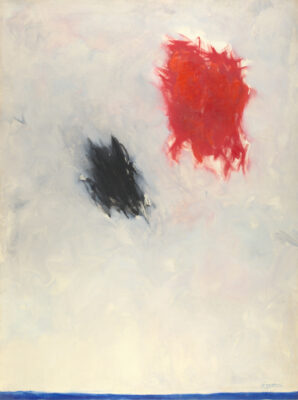
The youngest painter of the first generation of Abstract Expressionists, Stamos was one of the eighteen ‘Irascibles’ who protested against the Metropolitan Museum in 1950 and were photographed together for Life. His early paintings draw on shells, stones and fossils; around 1950 came the calligraphic Tea House pictures, and at the end of the decade the luminous, emptied fields of High Snow–Low Sun.
The Sun-Box paintings followed from 1962, and after 1971 the long series of Infinity Fields, many of them named for Lefkada, where he spent part of each year from 1970. He taught at Black Mountain College from 1950 to 1954 and for twenty years at the Art Students League of New York.
A close friend of Mark Rothko, Stamos was named an executor of his estate; the litigation that followed Rothko’s death in 1970 cost him his house and for many years overshadowed his reputation and his market. He died in Ioannina in February 1997 and is buried on Lefkada. A year before his death he gave forty-three works to the National Gallery in Athens. His paintings are in the Museum of Modern Art, the Whitney Museum of American Art, the Metropolitan Museum of Art and the Smithsonian American Art Museum.
References Wikipedia Wikidata Getty ULAN RKD