Get Notified
Be the first to know about new works by Vasudeo S. Gaitonde.
1924-2001 | Indian
V. S. Gaitonde; Vasudeo Santu Gaitonde; Vasudev S. Gaitonde; वासुदेव गायतोंडे
Indian Master of Non-Objective Painting
Vasudeo Santu Gaitonde was born in Nagpur in 1924 to a Goan family and grew up in Bombay, where he took his diploma at the Sir J. J. School of Art in 1948. In 1950 he was invited to join the Progressive Artists’ Group founded by Souza, Raza and Husain. His early work looks to Indian miniature painting and to Paul Klee; by the end of the 1950s the figure had disappeared from it, and he arrived at the painting he preferred to call non-objective, not abstract.
He showed in New York in group exhibitions in 1959 and 1963, lived there in 1964–65 on a Rockefeller Fellowship, where he saw the work of the Abstract Expressionists at first hand, and had a solo exhibition in the city in 1965. Zen Buddhism and East Asian calligraphy shaped both his thinking and his method: slow, solitary, a handful of canvases a year, the paint laid and lifted with rollers and palette knives until the surface seemed to hold light.
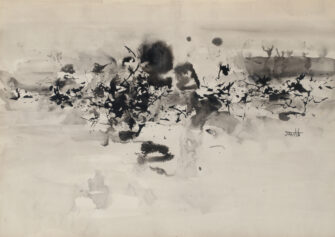
The black-and-white ink drawings of the early 1960s and the luminous canvases that followed are the core of his achievement. He was awarded the Padma Shri in 1971 and the Kalidas Samman in 1989–90, and spent his later decades in a small flat in Nizamuddin East, Delhi, working little and exhibiting less. He died in August 2001.
In 2013 one of his canvases became the most expensive Indian work of art then sold at auction, and in 2014–15 the Solomon R. Guggenheim Museum in New York gave him the retrospective ‘V. S. Gaitonde: Painting as Process, Painting as Life’. His work is in the Museum of Modern Art, New York, the National Gallery of Modern Art, New Delhi, the Tata Institute of Fundamental Research and the Jehangir Nicholson Collection, Mumbai.
References Wikipedia Wikidata Getty ULAN RKD