Get Notified
Be the first to know about new works by Jan Zrzavý.
1890-1977 | Czech
Czech Modernist Painter of Dreamlike Towns and Landscapes
Jan Zrzavý was born in 1890 in Okrouhlice, in the Bohemian-Moravian highlands, the son of a village schoolmaster. Largely self-taught after a brief spell at the Prague School of Applied Arts, he found his direction early: by 1910 he had joined the artists’ group Sursum and was painting the visionary, simplified pictures — ‘Cleopatra’, ‘Vale of Sorrow’ — that made him, with Kubišta and Filla, one of the founders of Czech modern art.
Zrzavý absorbed Cubism and the Italian primitives, Leonardo and Giotto, and fused them into a personal language of pure, rounded forms and luminous colour. He was a member of the Tvrdošíjní (‘The Stubborn Ones’) group after the First World War and later of the Mánes Union of Fine Arts.
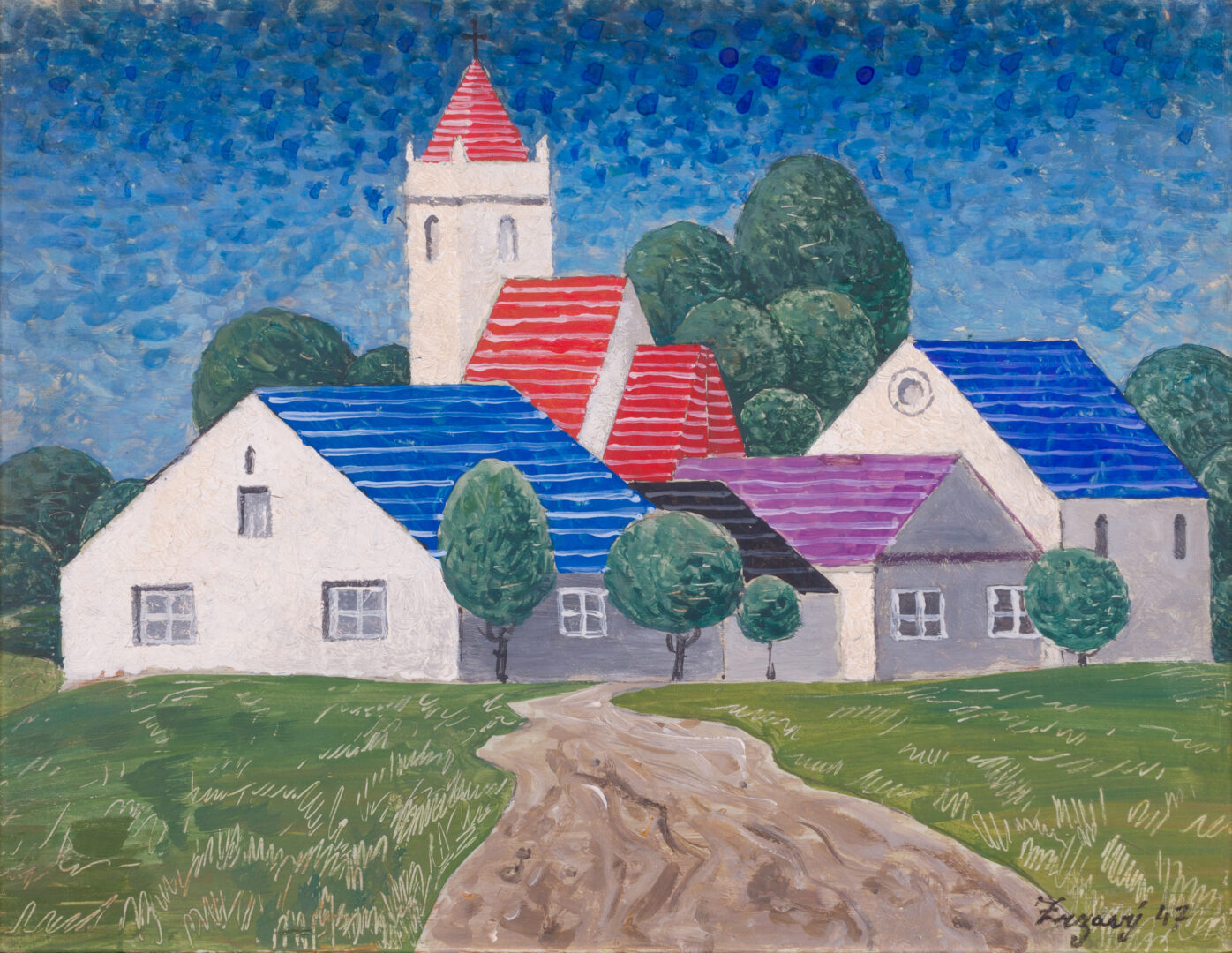
From the 1920s he divided his time between Prague, Brittany — whose boats and coast he painted for decades — and Venice, and after 1935 the highland villages of Krucemburk and Okrouhlice, which became the setting for his ‘little towns’ and ‘Bohemian-Moravian’ landscapes: white houses, red church spires, scratched fields of grass under dotted skies.
Named National Artist in 1966, Zrzavý is represented in the National Gallery in Prague, which devoted a major retrospective to him in 2015, and in Czech regional museums; a permanent exhibition of his work is at Krucemburk, where he is buried. He died in Prague in 1977.
References Wikipedia