Get Notified
Be the first to know about new works by Tahia Halim.
1919-2003 | Egyptian
Tahia Mohammed Halim; Tahiya Halim; تحية حليم
Egyptian Painter of Nubia
Tahia Halim was born in 1919 in Sudan, where her family was then living, and she grew up in the royal palace in Cairo, where her father served at the court of King Fuad I. She took private lessons from the Lebanese painter Youssef Trabelsi and the Greek painter Jerome, and from 1943 studied with the Egyptian painter Hamed Abdalla, whom she married in 1945. The couple spent 1949 to 1951 in Paris at the Académie Julian and on their return taught together in their own studio in Cairo.
In the 1950s she left the manner of her Paris years for an art rooted in Egyptian life, and in 1958 she received an award in the Guggenheim International competition in New York. The decisive journey came in 1962, when she travelled to Nubia with the artists sent by the Ministry of Culture to record the land that the Aswan High Dam was about to flood.
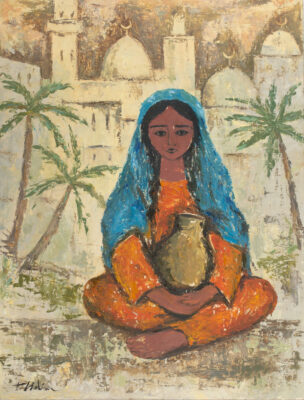
Nubia, its women and children, boats, weddings and domed white houses, became her lifelong subject. She painted it in earth colours, ochres above all, with thick paint scraped and rubbed to the texture of an old wall, and with the frontal, wide-eyed figures of ancient Egyptian and Coptic art. Critics count her among the pioneers of the modern expressive movement in Egyptian painting.
She received the gold medal for painting in 1960 and Egyptian state prizes in 1969 and 1996, and died in 2003. Her work is in the Museum of Modern Egyptian Art in Cairo, the Museum of Modern Art in Alexandria, Moderna Museet in Stockholm, the Barjeel Art Foundation in Sharjah and Darat al Funun in Amman.
References Wikipedia Wikidata Getty ULAN