
Giorgio de Chirico: from the Metaphysical Piazza to the Gladiators
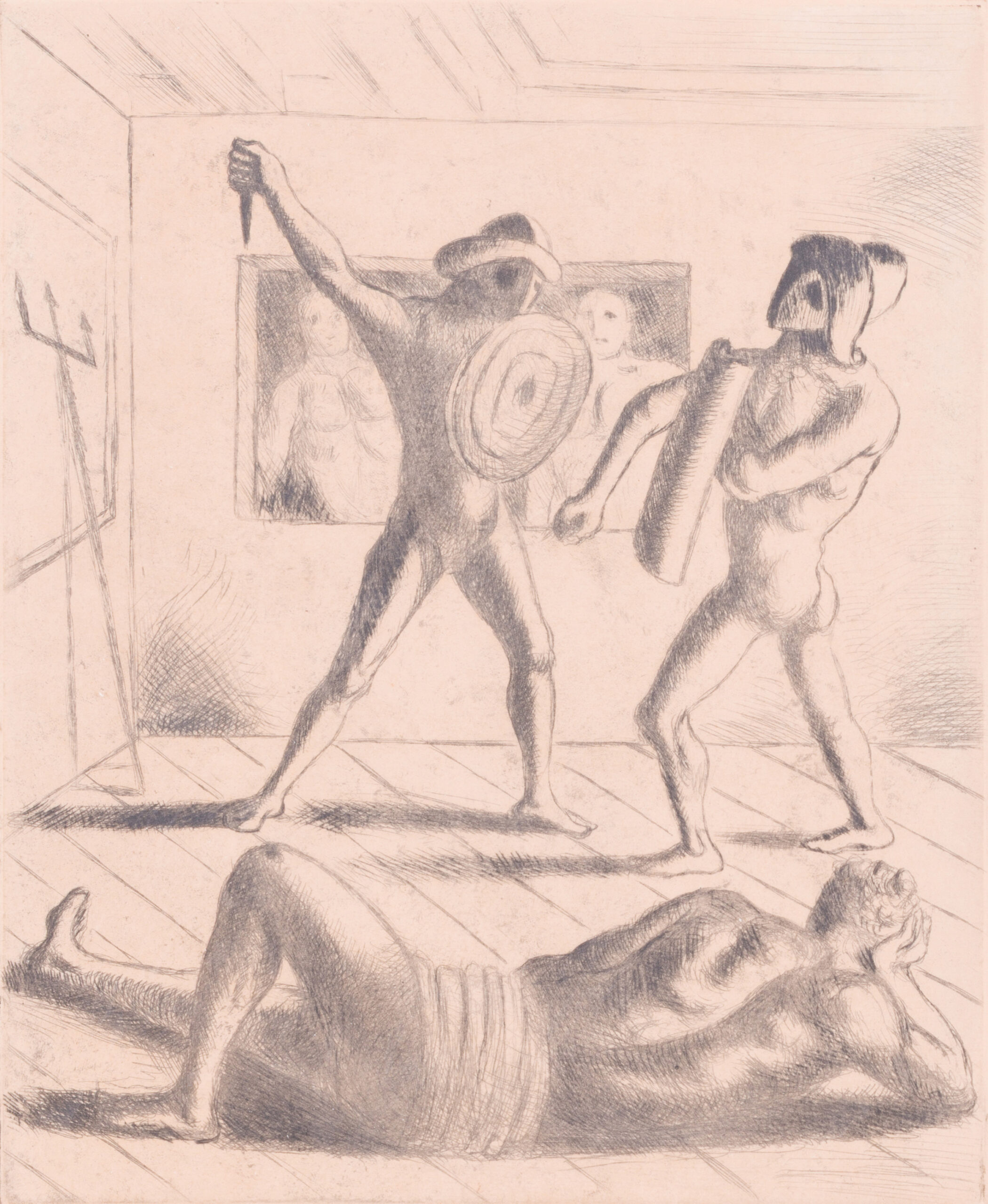
Giorgio de Chirico (1888–1978), founder of Metaphysical painting: Volos, Munich and Paris, the classical turn, the gladiator cycle of the late 1920s, and the engraving attributed to him at Aurora & Athena.
No twentieth-century painter is more clearly the author of a single idea than Giorgio de Chirico (1888–1978). The empty piazza, the long shadow, the mannequin and the distant train made him, before he was thirty, the founder of Metaphysical painting and the acknowledged ancestor of Surrealism. What he did afterwards — the classical turn, the gladiators, the self-portraits in costume — has taken a century to be understood. A gladiator engraving attributed to him is in our Maestros modernos: Arte del siglo XX sale.
Volos, Munich, Paris
De Chirico was born in Volos, Greece, in 1888, to Italian parents; his father was building the Thessalian railway. He studied in Athens and at the Munich Academy, where Böcklin’s painting and Nietzsche’s philosophy shaped his imagination, and arrived in Paris in 1911. The pictures he painted there over the next four years — the arcades of Turin and Ferrara, the towers, the statues and the ‘Song of Love’ with its rubber glove — were championed by Apollinaire, bought by Paul Guillaume and, after the war, seized on by Breton and the Surrealists as their founding revelation.
The classical turn and the gladiators
After the war de Chirico turned to the Old Masters, to Titian and Raphael, and to a ‘return to craft’ that provoked a lasting quarrel with Breton. The 1920s and 1930s brought the horses on the shore, the archaeologists with cities in their laps and, from 1927, the gladiators: heavy, deliberately archaic figures fighting in bare, box-like rooms, painted for the dealer Léonce Rosenberg’s Paris apartment and repeated for years afterwards in oil, drawing and print. The theme is at once antique and theatrical — the arena as a stage set, the combat oddly gentle.
En engraving in our sale shows three gladiators in such a room while a fourth lies fallen in the foreground and onlookers watch from an opening at the back. It is signed ‘G. de Chirico’ in pencil and is offered as attributed to the artist.
Rome and the late years
From 1944 de Chirico lived in Rome, in the house on Piazza di Spagna that is now his museum, painting neo-Baroque self-portraits and still lifes, remaking his own metaphysical pictures — to the fury of the critics — and, in his last decade, the ‘neo-metaphysical’ works that a younger generation embraced. He made prints and lithographs throughout his career and died in Rome in 1978. His work is in every major museum of modern art, from MoMA to the Centre Pompidou. More on his artist page.
At Aurora & Athena
Gladiators, engraving on paper attributed to Giorgio de Chirico, framed under glass, is offered on 17 October 2026 with an estimate of 1 500 – 2 000 €. Photographs, condition summary and bidding on the lot page.
Disponible ahora
Próximos lotes de subasta
Artista en este artículo
Own a Work by Giorgio de Chirico?
Los especialistas de Aurora & Athena ofrecen tasaciones gratuitas y pueden guiarle en el proceso de consignación para subasta o venta privada.
Obtén una valoración gratuita