Giorgio de Chirico: from the Metaphysical Piazza to the Gladiators
3 min read
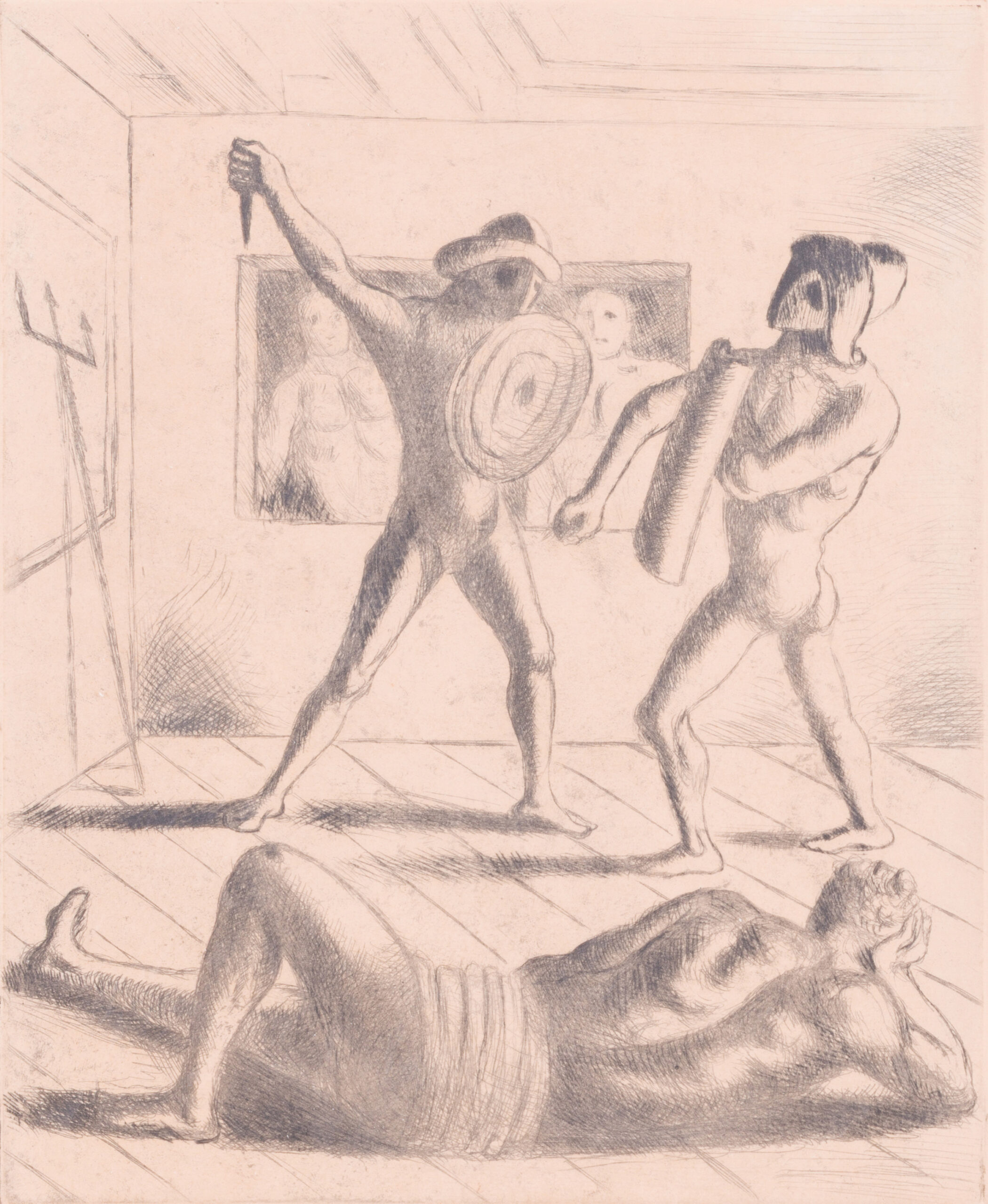
Engraving attributed to Giorgio de Chirico: gladiators fighting in a bare room

Giorgio de Chirico (1888–1978), founder of Metaphysical painting: Volos, Munich and Paris, the classical turn, the gladiator cycle of the late 1920s, and the engraving attributed to him at Aurora & Athena.

No twentieth-century painter is more clearly the author of a single idea than Giorgio de Chirico (1888–1978). The empty piazza, the long shadow, the mannequin and the distant train made him, before he was thirty, the founder of Metaphysical painting and the acknowledged ancestor of Surrealism. What he did afterwards — the classical turn, the gladiators, the self-portraits in costume — has taken a century to be understood. A gladiator engraving attributed to him is in our Modern Masters: 20th Century Art sale.
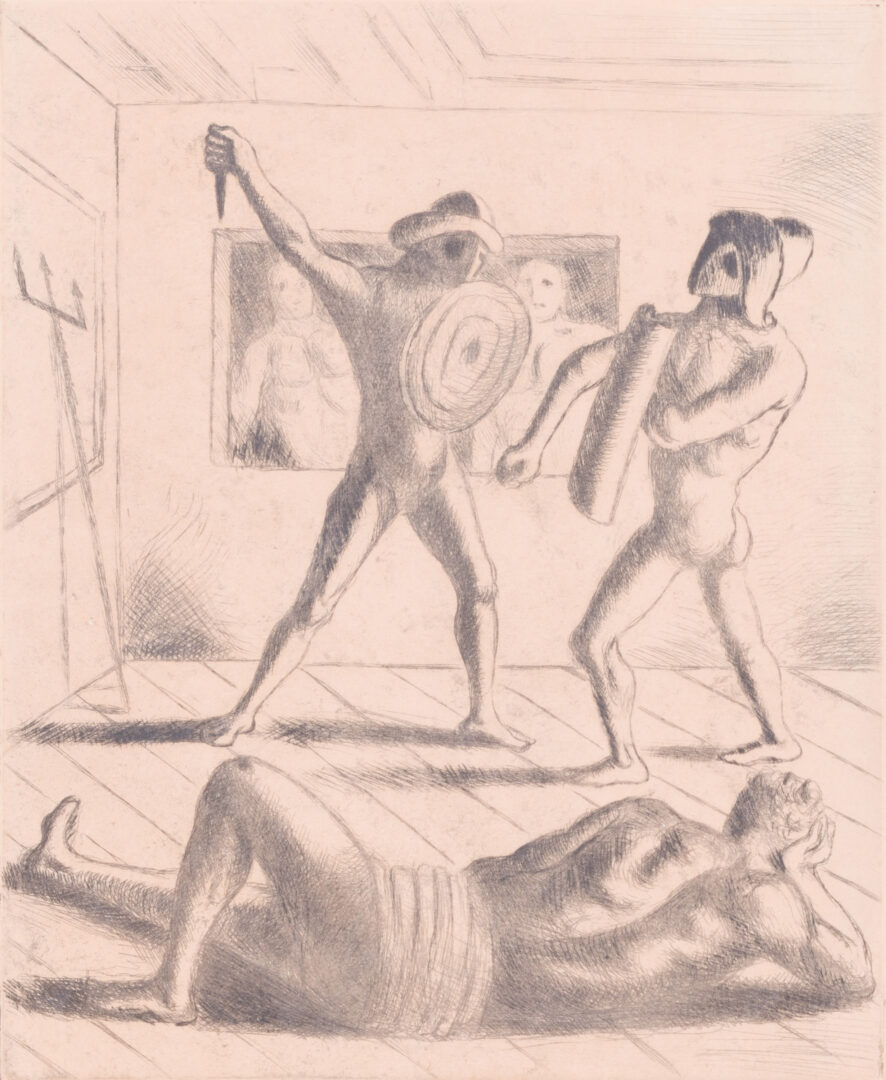
Engraving attributed to Giorgio de Chirico: gladiators fighting in a bare room
Lot 24 · Gladiators (Gladiatori) — Aurora & Athena, 17 October 2026

Volos, Munich, Paris

De Chirico was born in Volos, Greece, in 1888, to Italian parents; his father was building the Thessalian railway. He studied in Athens and at the Munich Academy, where Böcklin’s painting and Nietzsche’s philosophy shaped his imagination, and arrived in Paris in 1911. The pictures he painted there over the next four years — the arcades of Turin and Ferrara, the towers, the statues and the ‘Song of Love’ with its rubber glove — were championed by Apollinaire, bought by Paul Guillaume and, after the war, seized on by Breton and the Surrealists as their founding revelation.

The classical turn and the gladiators

After the war de Chirico turned to the Old Masters, to Titian and Raphael, and to a ‘return to craft’ that provoked a lasting quarrel with Breton. The 1920s and 1930s brought the horses on the shore, the archaeologists with cities in their laps and, from 1927, the gladiators: heavy, deliberately archaic figures fighting in bare, box-like rooms, painted for the dealer Léonce Rosenberg’s Paris apartment and repeated for years afterwards in oil, drawing and print. The theme is at once antique and theatrical — the arena as a stage set, the combat oddly gentle.

The engraving in our sale shows three gladiators in such a room while a fourth lies fallen in the foreground and onlookers watch from an opening at the back. It is signed ‘G. de Chirico’ in pencil and is offered as attributed to the artist.

Rome and the late years

From 1944 de Chirico lived in Rome, in the house on Piazza di Spagna that is now his museum, painting neo-Baroque self-portraits and still lifes, remaking his own metaphysical pictures — to the fury of the critics — and, in his last decade, the ‘neo-metaphysical’ works that a younger generation embraced. He made prints and lithographs throughout his career and died in Rome in 1978. His work is in every major museum of modern art, from MoMA to the Centre Pompidou. More on his artist page.

At Aurora & Athena

Gladiators, engraving on paper attributed to Giorgio de Chirico, framed under glass, is offered on 17 October 2026 with an estimate of 1 500 – 2 000 €. Photographs, condition summary and bidding on the lot page.

Available Now

Upcoming auction lots
#24 Attr. to Giorgio de Chirico - Gladiators (Gladiatori), c. 1930's
Lot 24

Attr. to Giorgio de Chirico (1888-1978)

Gladiators (Gladiatori), c. 1930's
24 × 18 cm | 9.4 × 7.1 in
Estimate 1,500–2,000 €
Starting at 1,000 €
Place bid
24
#24 Attr. to Giorgio de Chirico - Gladiators (Gladiatori), c. 1930's

Attr. to Giorgio de Chirico (1888-1978)

Gladiators (Gladiatori), c. 1930's · 24 × 18 cm | 9.4 × 7.1 in
Estimate 1,500–2,000 €
Starting at 1,000 €
Place bid

Artist in this article

Own a Work by Giorgio de Chirico?

Aurora & Athena's specialists provide free valuations and can guide you through consignment to auction or private sale.

Get a Free Valuation

Frequently Asked Questions

Have questions about participating in our auctions or submitting your artwork? Find answers to common inquiries below, or feel free to reach out for more details.
Our current selection of artworks available for private sale may be viewed in our Online Gallery.
Selected works may also be viewed in our showroom by prior appointment.
All Aurora & Athena auctions are held online. The simplest way to take part is to create an account on auroraathena.com: once approved, you can leave a maximum bid on any lot before the sale and bid live in our own auction room, with a buyer's premium of 25% — lower than on third-party platforms. Our sales are also listed on LiveAuctioneers, Invaluable, Drouot or BidSpirit, where the buyer's premium is 30%. See our How to Bid page for the full guide.
Not at the moment — we don't offer telephone bidding. You can bid from anywhere in the world in our own online auction room (create an account on auroraathena.com, 25% buyer's premium), or through LiveAuctioneers, Invaluable, Drouot or BidSpirit (30% buyer's premium).
Yes. Once your account on auroraathena.com is approved, open any lot in the catalogue and leave your maximum bid — we bid for you, step by step, only as far as needed, and you can raise or withdraw it until the lot comes up in the live sale. Your maximum is never shown to other bidders. Absentee bids can also be left on LiveAuctioneers, Invaluable, Drouot or BidSpirit, at their 30% buyer's premium. For the full guide, see our How to Bid page.
Yes. All artworks may be viewed in our showroom by appointment only. We encourage collectors to inspect artworks in person whenever possible.
Credit card payments are accepted for purchases up to €10,000. Purchases exceeding this amount must be paid by bank wire transfer.
For auction purchases, payment is due within 14 days of the auction. For gallery purchases and private sales, payment terms are agreed individually.
For purchases of €1,000 or more, buyers must complete our client registration (KYC) procedure before the transaction can be finalized. Required documentation includes a completed Client Registration Form, a valid passport or national ID, and proof of address dated within the last three months.
For auction purchases, where applicable, KYC documentation and payment must both be completed within 14 days of the auction.
Yes. Artworks may be collected by appointment or shipped worldwide. For every purchase — at auction, through the gallery, or via a private sale — Aurora & Athena coordinates professional, insured shipping on your behalf with trusted logistics partners. If you'd prefer to arrange your own shipping instead, we're happy to work with a provider of your choice.
It’s easy! Just fill out the form on our website: auroraathena.com/sell — or email us at sell@auroraathena.com. Be sure to include key details like the artist, technique, size, and clear photos of the artwork (front, back, and signature if possible). The more information you provide, the better we can evaluate your submission. We’ll get back to you as soon as we review it!
Auction purchases are governed by our Auction Terms & Conditions. Gallery purchases and private sales are governed by our Gallery Terms & Conditions.
If you require any additional information regarding our auctions, gallery, private sales or services, we would be delighted to assist. Contact us via our Contact page or email contact@auroraathena.com.

Stay ahead of the art world

Sign up for our newsletter to receive exclusive updates on upcoming auctions, new catalog releases, and more!