
Pan Yuliang: China’s First Modern Woman Painter, in Paris
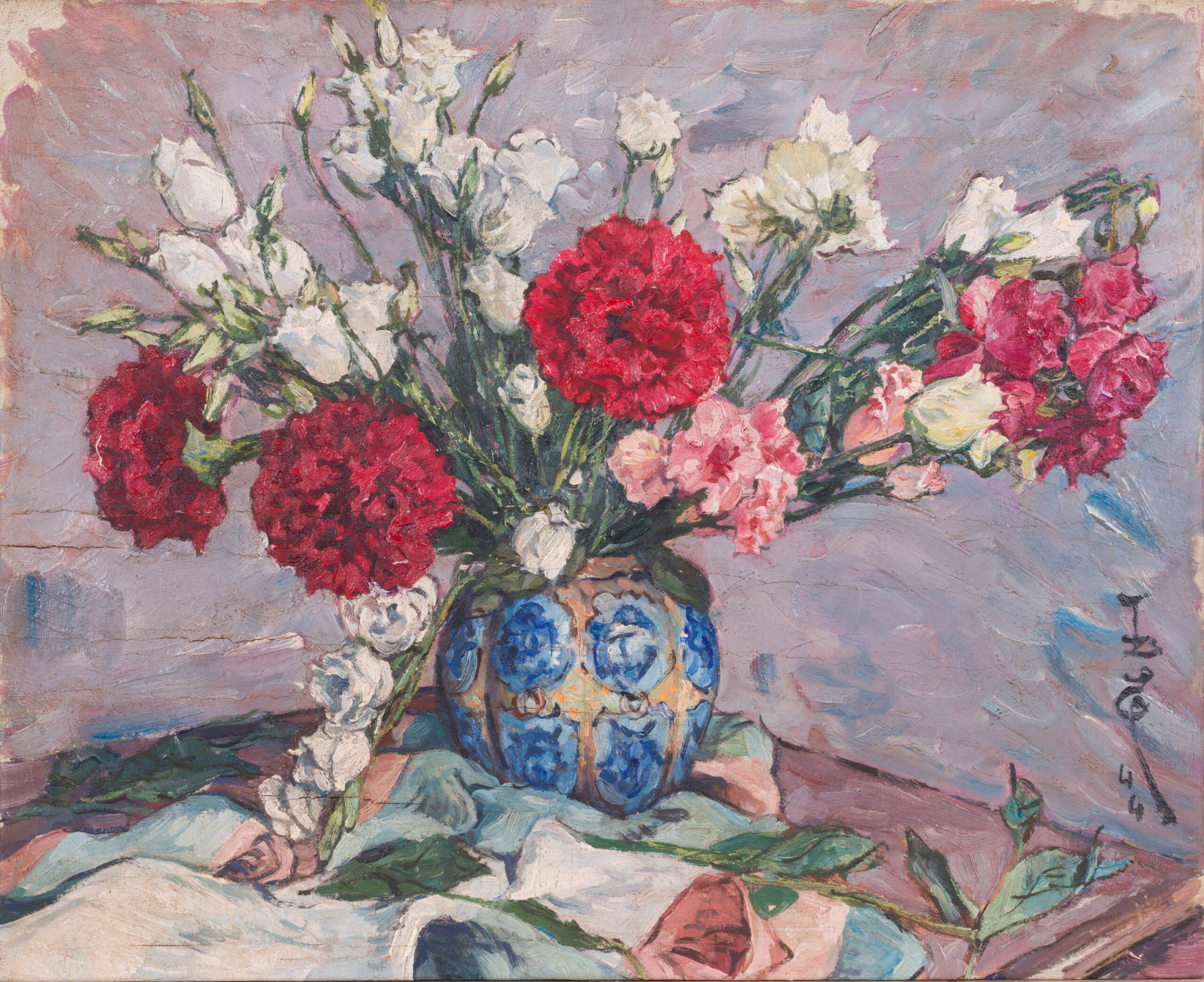
Pan Yuliang (1895–1977), from Yangzhou to Montparnasse: her training, her flower still lifes and nudes between Chinese line and Parisian colour, and the 1944 canvas attributed to her at Aurora & Athena.
The life of Pan Yuliang (1895–1977) has been told in novels and films, and it is easy to see why: an orphan sold into a brothel who became the best-known woman painter of Republican China and then, for forty years, a fixture of Montparnasse. But the biography has tended to eclipse the painter. With a flower still life attributed to her in our Modern Masters: 20th Century Art sale, here is a look at the work itself.
From Yangzhou to Paris
Born Chen Xiuqing in Yangzhou in 1895, she was orphaned as a child and sold to a brothel in Wuhu, where the customs official Pan Zanhua bought her freedom and married her. He encouraged her to study; in 1920 she entered the Shanghai Art Academy as one of its first women students, and in 1921 won a scholarship to France. She studied at the École des Beaux-Arts in Lyon, then in Paris under Lucien Simon, and finally in Rome at the Accademia di Belle Arti — a classical European training that few Chinese artists of her generation received.
Back in China in 1928 she taught at the Shanghai Academy and the Central University in Nanjing and exhibited widely, becoming the most celebrated woman artist of the Republic. Her nudes, and her past, drew hostility, and in 1937 she returned to Paris for good.
A painter between two traditions
In her small studio on the rue de la Grande-Chaumière Pan Yuliang painted for four decades: nudes and self-portraits, dancers, cats, and above all flowers — often in a Chinese vase against a flat, patterned ground, the composition anchored by a sweep of drapery. Her manner married Post-Impressionist colour with the line and rhythm of Chinese painting; from the 1940s she also worked in ink and colour on paper, drawing the nude with a calligrapher’s brush.
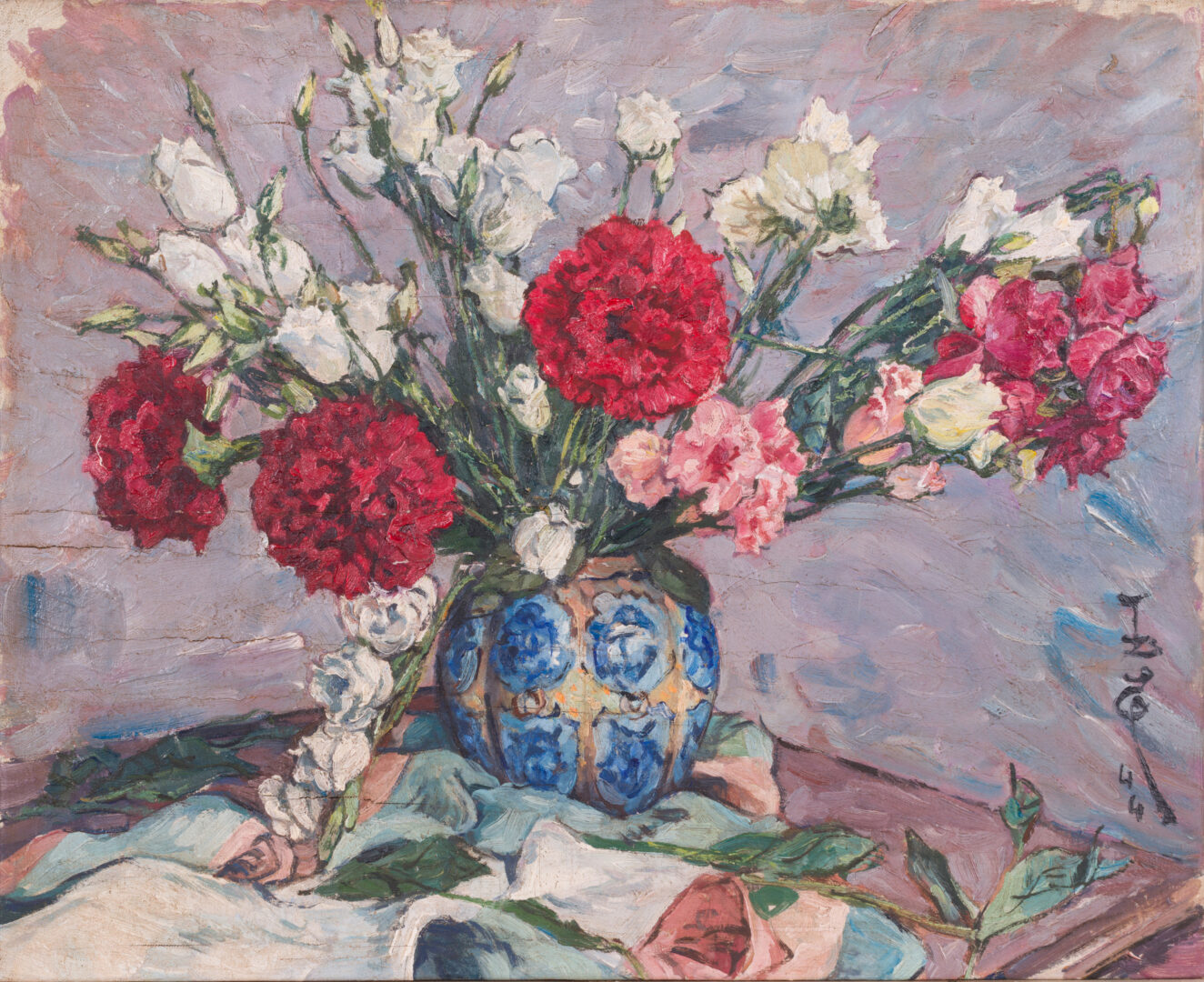
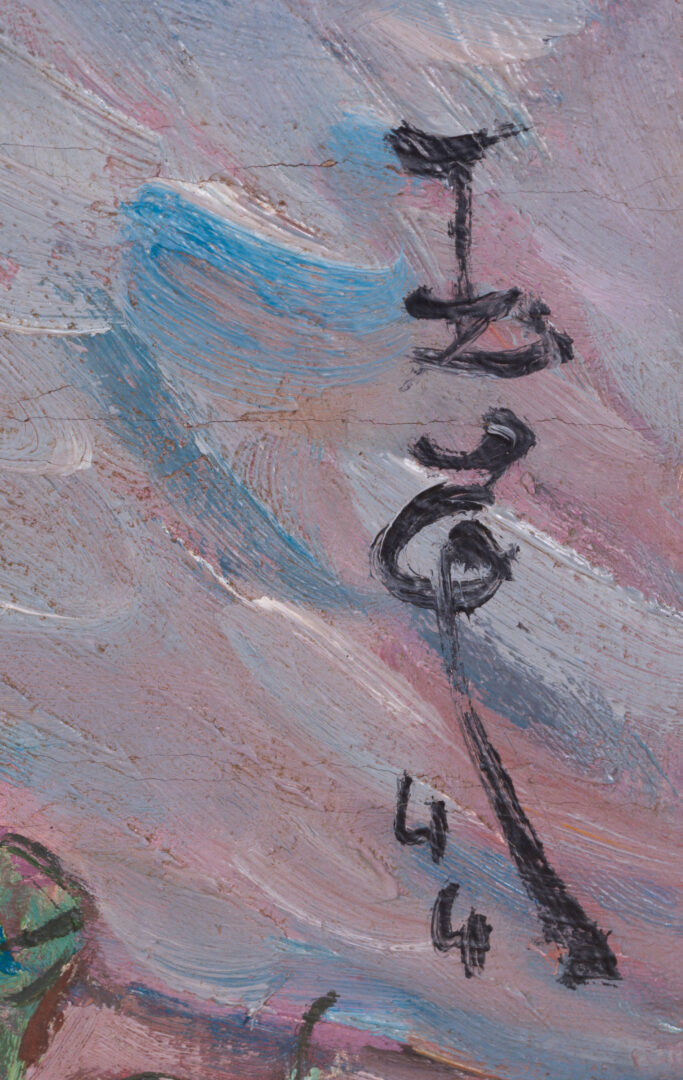
The canvas in our sale — carnations, roses and blossom bursting from a blue-and-white vase against a mauve wall, signed in Chinese characters and dated ‘44’ — belongs to this Paris production of the war years. It is offered as attributed to the artist; the composition, the thick directional brushwork and the Chinese vase are all characteristic of her flower pieces of the period.
Legacy and rediscovery
Pan Yuliang exhibited at the Paris salons and was honoured by the city, but refused to sell her work abroad; after her death in 1977 more than four thousand works went to the Anhui Provincial Museum and the National Art Museum of China. Her rediscovery began in the 1990s, and her paintings now set records for a Chinese woman artist at auction, with the Paris-period oils the most sought after. More on her artist page.
At Aurora & Athena
Carnations and Roses in a Blue-and-White Vase, 1944, attributed to Pan Yuliang, is offered on 17 October 2026 with an estimate of 3 000 – 4 000 €. Photographs, condition summary and bidding on the lot page.
Available Now
Upcoming auction lots
Artist in this article
Own a Work by Pan Yuliang?
Aurora & Athena's specialists provide free valuations and can guide you through consignment to auction or private sale.
Get a Free Valuation