
École de Paris Painters: 2 Names Worth Discovering
Jules Pascin and Tsuguharu Foujita were both part of the École de Paris — one holds a $9.4M auction record. Their real biographies, market data, and the available original paintings in Aurora & Athena's own collection.
Table of Contents
Jules Pascin was called the “Prince of Montparnasse” — until 1930, when a string of bad reviews sent him into his studio, where he wrote a final message to his lost love in his own blood and took his own life. On the day of his funeral, every gallery in Paris closed. Tsuguharu Foujita arrived from Tokyo the same era, sold out his debut Paris show on its first day, and became so famous for painting cats that his 1930 book on the subject is ranked among the most desirable cat books ever published. One of his paintings has since sold for $9.4 million at auction.
Both were genuine Ecole de Paris painters — and Aurora & Athena currently holds an original, available work by each. This guide covers what the École de Paris actually was, who Pascin and Foujita were within it, and where their work as Ecole de Paris painters sits in today’s market.
What Was the École de Paris?
The term “École de Paris” — School of Paris — was coined in 1925 by the critic André Warnod to describe something that wasn’t really a school at all: the wave of independent, avant-garde artists, many of them foreign-born, who converged on Paris between the world wars. It wasn’t a movement with a manifesto, the way Cubism or Surrealism was. It was a description of a place and a moment — Montmartre and, later, Montparnasse — where painters working in wildly different styles happened to be inventing modern art side by side.
Picasso, Matisse, Modigliani, Chagall and Soutine are the Ecole de Paris painters most associated with the label today. But the École de Paris was, by definition, bigger than its most famous members — a genuine international community, with painters arriving from Bulgaria, Japan, Italy, Russia and beyond to work in the same cafés and studios. Pascin and Foujita were both part of that wider circle, and both are now firmly documented within it.
Jules Pascin: The Prince of Montparnasse
Jules Pascin was born Julius Mordecai Pincas on 31 March 1885 in Vidin, Bulgaria, the eighth of eleven children of a Sephardic Jewish father and a Serbian-Italian mother. The family moved to Bucharest in 1892, and Pascin left for boarding school in Vienna in 1896, later training in Vienna and Munich before arriving in Paris and falling in with the Montparnasse circle. He became an American citizen along the way, but Paris — and specifically its café society — is where his identity as an artist took shape.
His most frequent subject, across a prolific career, was women — usually depicted nude or partly dressed, in casual, unposed attitudes rather than formal studio compositions. That informality, and a light, fluid line, became his signature. By 1930 he was successful enough to hold a major solo exhibition at the prestigious Galerie Georges Petit. Two days after it opened, following a run of harsh reviews of an earlier New York show, Pascin took his own life in his studio, leaving a farewell message written in blood on the wall. He was 45.
Among Ecole de Paris painters, Pascin’s market today reflects both his real stature and his prolific output: his auction record stands at $462,000, for Femme en Robe Rose in 1990, with a more recent high of $367,007 set at Christie’s London in 2023. Away from those headline results, his paintings have averaged around $26,433 at auction over the past year, and works on paper considerably less — a spread wide enough that a genuine, original Pascin is within reach of a first-time collector, not only a major buyer.
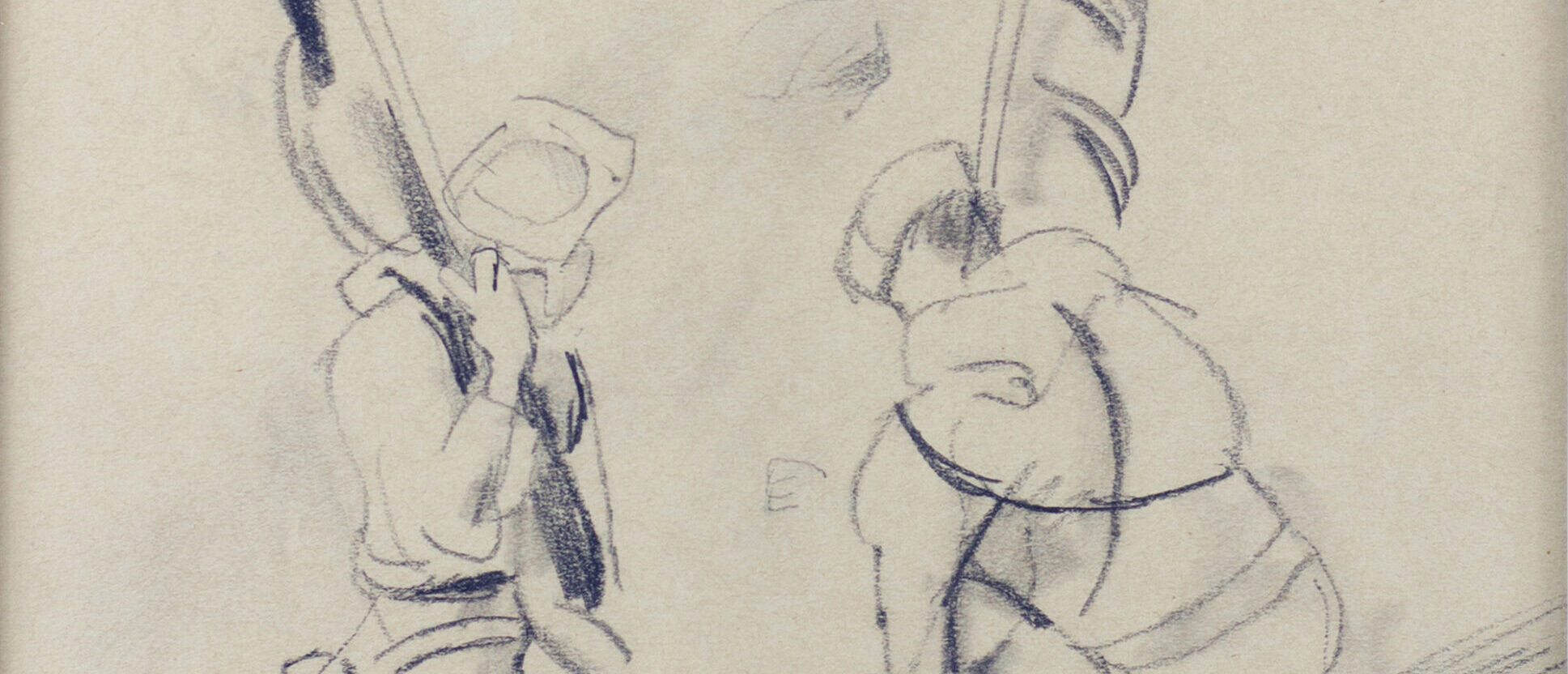
Aurora & Athena’s Two Figures with Flags — a charcoal drawing on paper — is a smaller work in that accessible range: an original Pascin without the seven-figure price tag.
Tsuguharu Foujita: Cats, Kimonos, and a New Name
Tsuguharu Foujita was born in Tokyo on 27 November 1886 and graduated from what is now the Tokyo National University of Fine Arts and Music in 1910. Three years later he moved to Paris, settling into the Montparnasse circle alongside Picasso, Matisse and Modigliani. Success came fast and hard: his debut solo exhibition of 110 works sold out on its opening day, and after a major 1918 exposition he became genuinely famous — for portraits of women rendered in a distinctive, luminous technique that fused Japanese ink methods with Western oil painting, and, just as much, for his paintings of cats.
Foujita’s affection for cats wasn’t incidental — he painted and drew them constantly, and his 1930 Book of Cats, illustrated with 20 of his own etched plates, is still ranked among the most desirable and valuable cat books ever published. His later life took a different turn: after imperial-era sympathies made Japan difficult for him following the Second World War, he emigrated back to France in 1950, was naturalised as a French citizen in 1955, converted to Catholicism, and took the Western name Léonard — becoming, officially, Léonard Tsuguharu Foujita. He died in 1968.
Foujita’s market has genuinely accelerated in recent years. His auction record is $9.4 million (£7.1 million), set in October 2018 at Bonhams London for La fête d’anniversaire (1949) — a result that hammered at six times its pre-sale estimate. An earlier high, $6,050,000 for Jeune Fille Dans le Parc, had stood since 1990. Those are headline results for major, museum-scale canvases; Foujita’s smaller and paper-based works trade at a small fraction of that, which is where a first collector’s entry point actually sits.
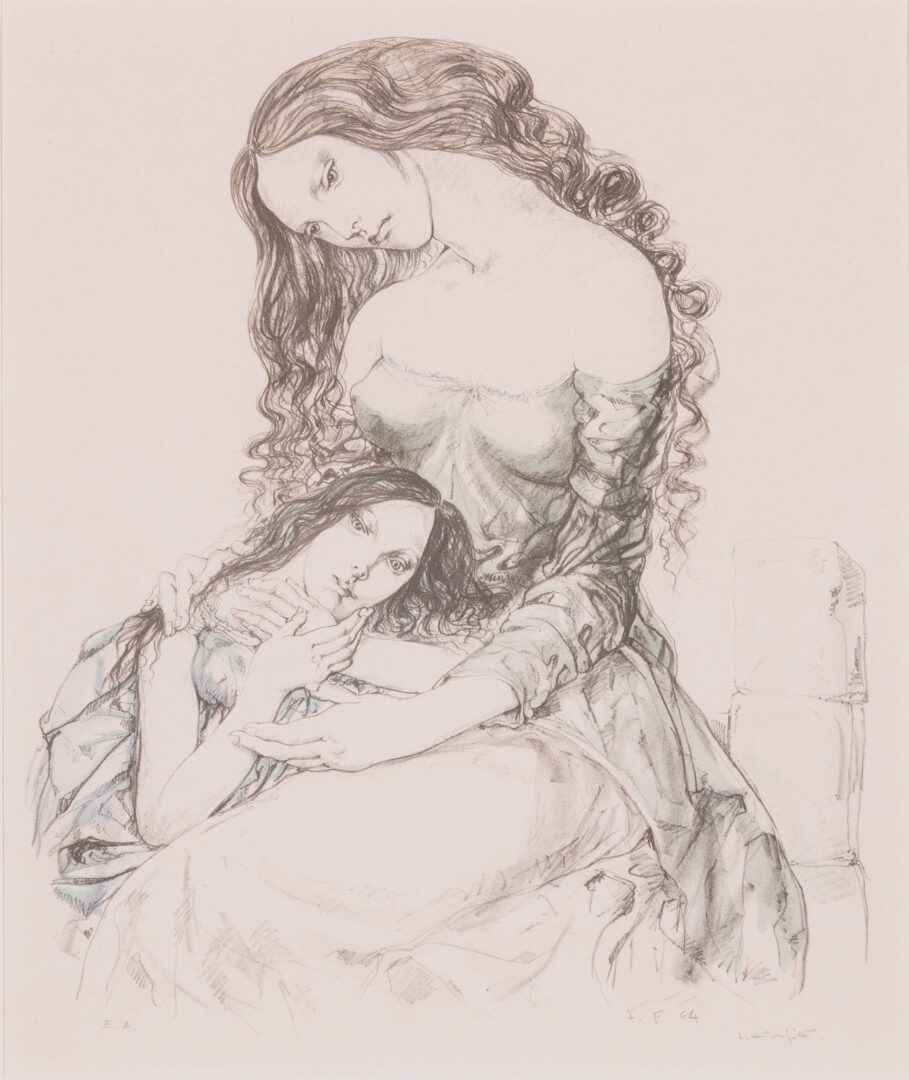
Aurora & Athena’s Mother and Child — a lithograph on paper — is exactly that kind of accessible original: the same artist behind that $9.4 million record, at a price built for a first Foujita rather than a museum acquisition.
Why École de Paris Painters Are Worth Collecting
Ecole de Paris painters sit in an unusual position in the market: its headline names — Foujita among them — now command genuinely major-auction prices, while the wider circle around them still trades at levels a first-time collector can realistically enter. That’s a different proposition from either end of the market on its own. A pure blue-chip name gives you no accessible entry point at all; a genuinely obscure name gives you accessibility but no real track record. École de Paris painters with documented auction histories, like Pascin and Foujita, offer both at once — real market data behind the name, and a range of prices within it wide enough to include a modest paper work alongside a museum-scale canvas.
Provenance matters more here than with a contemporary artist: both painters have been dead for decades, both have real forgery risk given their market value, and both are documented well enough — auction databases, museum holdings, dedicated reference sites — that a buyer can actually check a piece’s history rather than take a dealer’s word for it. A gallery-attributed original with a clear sale record, like the pieces in Aurora & Athena’s own collection, carries more confidence than one bought without any paper trail.
If you’re new to buying at auction, our guide to how bidding works covers the practical side before your first sale.
Frequently Asked Questions
What is the École de Paris?
École de Paris — School of Paris — is the term critic André Warnod coined in 1925 for the wave of independent, often foreign-born artists who converged on Paris between the two World Wars, working in Montmartre and Montparnasse. It wasn’t a single style or movement; Picasso, Matisse, Modigliani, Chagall, Pascin and Foujita all fall under the term despite painting very differently from one another.
Who were Jules Pascin and Tsuguharu Foujita?
Jules Pascin (1885–1930), born in Bulgaria, was known as the “Prince of Montparnasse” for his fluid, informal paintings of women, and died by suicide in his Paris studio. Tsuguharu Foujita (1886–1968), born in Tokyo, became famous in Paris for portraits and paintings of cats that fused Japanese ink technique with Western oil painting; he later took French citizenship and the name Léonard.
How much do École de Paris paintings sell for at auction?
Prices for Ecole de Paris painters vary enormously by name and by piece. Foujita’s auction record is $9.4 million, set in 2018; Pascin’s stands at $462,000. Away from those headline results, both artists’ smaller and paper-based works trade far lower — Pascin’s paintings have averaged around $26,433 over the past year, with works on paper considerably less — putting a genuine original within reach of a first-time collector.
Where can I buy École de Paris paintings today?
Among Ecole de Paris painters, Aurora & Athena currently holds one available original by each of the two covered here — Pascin’s Two Figures with Flags and Foujita’s Mother and Child. Beyond that, École de Paris works surface regularly at major auction houses and through dealers specialising in early-to-mid-twentieth-century Paris painting.
Available Now
Available at the gallery
Artists in this article

Considering Selling a Piece From Your Collection?
Aurora & Athena's specialists provide free valuations and can guide you through consignment to auction or private sale.
Get a Free Valuation