
Gerard Sekoto: 7 Masterful Epochs of the Definitive Pioneer of African Modernism
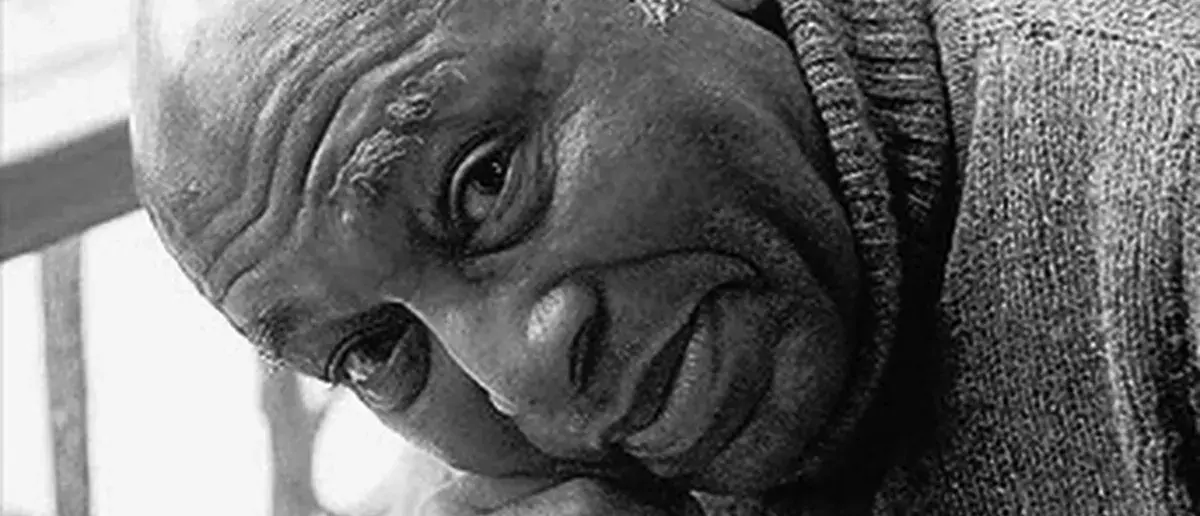
Discover the life, seminal paintings, and enduring legacy of Gerard Sekoto, the definitive pioneer of African modernism and social realism. Trace his extraordinary journey from Sophiatown and District Six to his long exile in Paris, and explore the artistic and auction impact of South Africa's iconic master.
Table of Contents
Gerard Sekoto stands as an indispensable titan in twentieth-century visual culture, universally recognized as the definitive pioneer of African modernism and social realism. Through an unflinching yet compassionate brush, Gerard Sekoto recorded the dignity, dynamic pulse, and quiet human resilience of Black urban communities during a pivotal transformation in South African history.
His oeuvre represents far more than an aesthetic achievement in light, color, and form. The paintings of Gerard Sekoto endure as irreplaceable visual evidence of pre-Apartheid urban centers that were subsequently demolished by state legislation.
For art historians, international institutions, and discerning collectors reviewing curated masterworks at Aurora Athena Fine Art Auctions, tracing his trajectory reveals how personal resilience birthed a globally influential visual language.
This research report provides an exhaustive, multi-dimensional analysis of the life, technical development, artistic evolution, market trajectory, and legacy of Gerard Sekoto across seven distinct epochs.
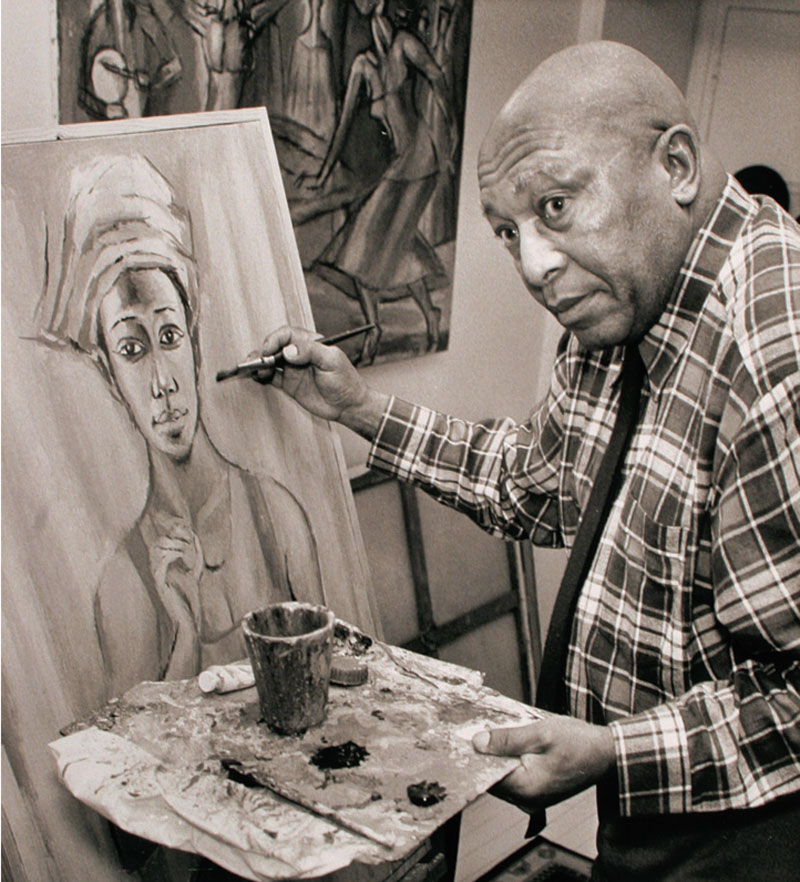
Early Roots and Spiritual Foundations in Botshabelo
G. Sekoto was born on December 9, 1913, at the Lutheran Mission Station in Botshabelo, situated near Middelburg in the Eastern Transvaal (now Mpumalanga). His early environment was defined by rigorous academic discipline, Christian theology, and rich musical traditions.
His father, Andreas Sekoto, worked as a respected priest, educator, and lay physician who traveled the surrounding countryside in a horse-drawn cart alongside a Scottish doctor. His grandfather was among the earliest regional converts to Christianity and served as a lay pastor dispatched to Berlin to assist in translating the Holy Bible into Northern Sotho.
From early childhood, G. Sekoto felt an overwhelming compulsion to depict the human environment around him. He began modeling small animal figurines out of river clay and drawing on his older brother’s school slate before progressing to paper and pencil.
Adhering to family expectations, G. Sekoto enrolled in 1930 at the Diocesan Training College (Grace Dieu), an Anglican teacher training institution near Pietersburg (now Polokwane). There, he began rendering delicate portraits of fellow students and designing official institutional emblems.
In 1934, G. Sekoto graduated and secured a teaching position in the primary department of Khaiso Secondary School near Pietersburg. During this teaching tenure, he refined his watercolor and tempera techniques while absorbing European art history books, finding profound inspiration in the works of Vincent van Gogh.
A decisive turning point occurred in 1938 when Gerard Sekoto entered the May Esther Bedford Art Competition, organized by Fort Hare University. Receiving second prize, the award provided him with the financial confidence to resign from teaching and commit entirely to a professional art career.
The Sophiatown Realism of Gerard Sekoto
In late 1938, Sekoto moved to Sophiatown, a vibrant, racially integrated freehold township situated on the outskirts of Johannesburg. Sophiatown served as a dynamic cultural crucible for jazz musicians, political thinkers, writers, and visual creators.
Upon establishing himself in Johannesburg, Gerard Sekoto forged vital links with a progressive circle of liberal white artists and patrons. The artist Judith Gluckman welcomed him into her private studio, where she taught him oil painting techniques—an act strictly prohibited under prevailing segregationist social customs.
Simultaneously, the artist Alexis Preller presented G. Sekoto with his first tubes of professional oil paint, while gallery director Joan Ginsberg championed his emerging work at the Gainsborough Gallery. Brother Roger Castle of St. Peter’s School in Rosettenville also provided critical encouragement and studio access.
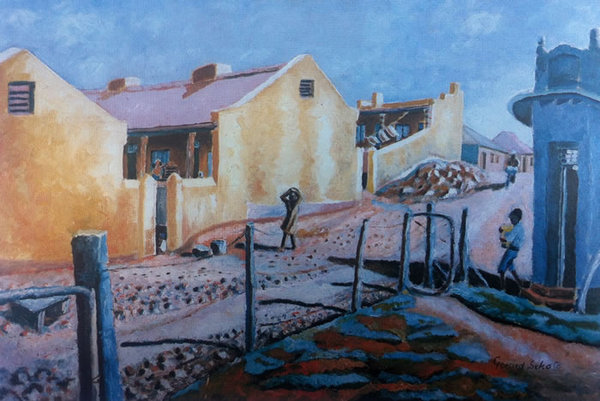
Sekoto consciously rejected picturesque rural themes in favor of documenting the energy, domestic routines, and underlying social tensions of urban Black everyday life. He captured early morning worker commutes, children playing on unpaved streets, and quiet shebeen gatherings framed by corrugated iron architecture.
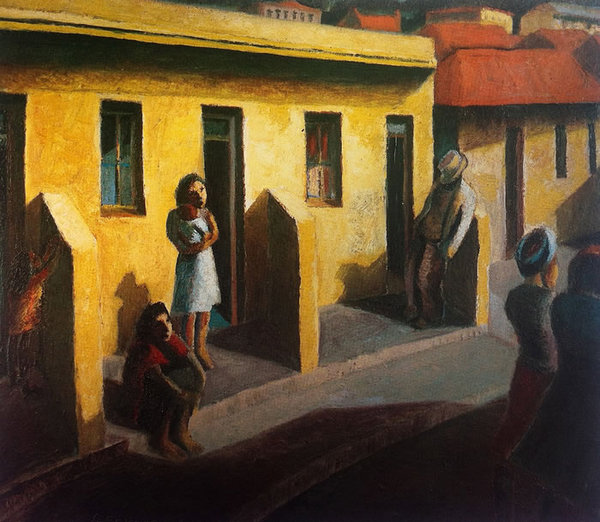
In 1940, G. Sekoto achieved a historic milestone when the Johannesburg Art Gallery purchased his oil painting Yellow Houses – A Street in Sophiatown. This acquisition marked the first time a major South African public museum acquired an artwork by a Black artist—a record that remained unique within the institution for thirty-two years.
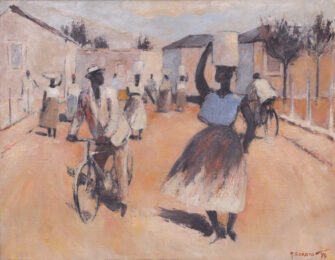
Another masterpiece from this period, Cyclists in Sophiatown (1940), demonstrated his expanding mastery of spatial structure and natural light. Utilizing strong diagonal lines, rhythmic roof contours, and crisp morning sunlight, Sekoto elevated ordinary commuters into figures of quiet dignity.
District Six and the New Group Era
Seeking to expand his understanding of South African society, Sekoto relocated to District Six in Cape Town in 1942. District Six was a dense, multi-ethnic coastal enclave renowned for its cosmopolitan spirit, musical street life, and political awareness.
In Cape Town, G. Sekoto became an active member of the ‘New Group’, a prominent association of progressive visual artists. The New Group sought to challenge conservative academic artistic conventions and advocate for improved working conditions for professional artists.
Exhibiting alongside white contemporaries, Sekoto earned critical acclaim and steady commercial patronage across South Africa. His color palette shifted markedly during his Cape Town residence, absorbing the bright coastal light and pastel architectural tones of District Six.
His canvases from District Six frequently depicted street interactions, communal washing areas, and working families navigating urban existence. Rather than viewing his subjects through exotic detachment, Gerard Sekoto painted with intense human empathy and emotional closeness.
When the Apartheid administration subsequently implemented the Group Areas Act of 1950, District Six was declared a white area, leading to the forced displacement of 60,000 non-white residents and the demolition of their homes. Consequently, the District Six paintings of Gerard Sekoto stand as irreplaceable documentary records of an obliterated community.
The Eastwood Period: Peak Mastery of Gerard Sekoto
In 1945, Gerard Sekoto moved to Eastwood, a mixed-race township located outside Pretoria, where he resided with his mother and stepfather. Art historians universally regard the Eastwood period (1945–1947) as the absolute artistic high point of his South African career.
During these two prolific years, Gerard Sekoto elevated his technical command of saturated color theory, solid sculptural form, and psychological nuance. His compositions from Eastwood exude a rhythmic gravitas, emotional weight, and compositional clarity.
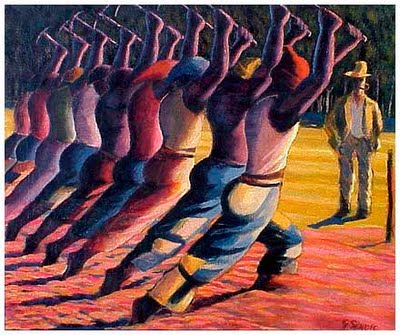
In 1946, Gerard Sekoto created his social realist masterpiece, Song of the Pick. Inspired by a black-and-white press photograph by Andrew Goldie, the painting depicts a line of Black laborers swinging picks in synchronized motion.
The composition utilizes dynamic diagonal planes, positioning the faceless mass of workers in a posture of physical strength and unified collective power. Standing opposite them is a solitary white overseer, hands thrust passively into his pockets, visually dwarfed by the moral authority of the laborers.
In the same year, Gerard Sekoto executed his haunting Self-Portrait (1946), capturing his personal anxiety regarding the country’s social trajectory. Decades later, this poignant self-portrait was chosen as the signature image for the Paris Noir exhibition at the Centre Pompidou.
Gerard Sekoto in Paris: Exile, Jazz, and Global Modernism
Recognizing that tightening racial segregation would severely restrict his creative freedom, Gerard Sekoto made the choice to go into voluntary exile. In October 1947, he boarded a ship for Paris, France, seeking to measure his artistic talent at the center of international modernism.
Just months after his departure, the National Party won the 1948 South African general election and formally institutionalized Apartheid. Gerard Sekoto would never return to the country that inspired his art.
His early years in post-war Paris were defined by financial struggle and profound personal solitude. To cover his living expenses and art tuition at the Académie de la Grande Chaumière, Gerard Sekoto worked as a nightly pianist and vocalist at L’Échelle de Jacob, a popular Left Bank jazz venue.
Music provided both financial survival and a creative output for his deep nostalgia. He composed original songs fusing American jazz idioms with melancholic African melodies, which were later rediscovered and recorded by modern musicologists.
In 1949, Gerard Sekoto held his first Parisian solo exhibition at Galerie Else-Claussen. While initial commercial sales were modest, a favorable feature article in Time Magazine in October 1949 enhanced his international profile.
Throughout his exile in France, Gerard Sekoto integrated elements of Impressionism, Cubism, and Orphism into his painting style. Yet, despite incorporating Western modernist formal techniques, his subject matter remained rooted in memories of South African township life and human labor.
In 1966, Gerard Sekoto spent two months in Senegal attending the First World Festival of Negro Arts (Premier Festival Mondial des Arts Nègres). This visit catalyzed his “Blue Period,” characterized by oil and gouache compositions drenched in deep ultramarine and cobalt tones.
During the 1970s and 1980s, as global anti-Apartheid resistance intensified, the paintings of Gerard Sekoto adopted an increasingly explicit political stance, denouncing state violence in South Africa.
Formal Style, Palette Evolution, and Technique of Gerard Sekoto
The complete artistic production of Gerard Sekoto spans four distinct geographic and stylistic phases. Each era brought refined shifts in medium, brushwork, chromatic balance, and structural composition.
| Stylistic Epoch | Geographic Location | Key Mediums Used | Primary Aesthetic Features | Representative Masterpieces |
|---|---|---|---|---|
| Sophiatown Period (1938–1942) | Johannesburg, South Africa | Watercolors, poster paint, transitioning to oils | Warm earth tones, dramatic light contrasts, urban street scenes, geometric corrugated roofs | Yellow Houses – A Street in Sophiatown (1940), Cyclists in Sophiatown (1940) |
| District Six Period (1942–1945) | Cape Town, South Africa | Oil paints on canvas and board | Pastel architecture, bright coastal sunlight, group genre scenes, washday movement | District Six Washday, Street Scene in District Six[cite: 5, 8, 10] |
| Eastwood Period (1945–1947) | Pretoria, South Africa | Saturated oils on heavy canvas | High color saturation, sculptural figures, rhythmic worker compositions, sharp diagonals | Song of the Pick (1946), Self-Portrait (1946), Woman in the Country |
| Parisian Exile Era (1947–1993) | Paris, France & Senegal | Oils, gouache, ink on paper | Synthesis of Cubism/Orphism, expressive brushwork, West African cobalt blue palettes | Three Children, The Smoker (1993), Senegal gouaches |
Gerard Sekoto possessed an ability to translate human emotion directly into visual structure. Similar to Vincent van Gogh, he formulated a visual language where directional brushstrokes and chromatic harmonies conveyed internal feeling.
Rather than detailing individual facial features, Gerard Sekoto frequently rendered figures with simplified, faceless contours. This stylistic choice converted specific township residents into universal symbols of Black resilience, dignity, and human solidarity.
The Secondary Art Market and Auction Records for Gerard Sekoto
In the global secondary art market, works by Gerard Sekoto command substantial interest among private collectors, corporate holdings, and public institutions. Canvases produced during his South African period—specifically Sophiatown and Eastwood—fetch premium valuations.
In 2011, a world auction record for Gerard Sekoto was established in London when his oil painting Yellow Houses, District Six achieved £602,400 (over R7 million) at auction.
Domestic auctions in South Africa have similarly recorded strong market figures. The premier South African auction house Strauss & Co set a firm regional benchmark when Woman in the Country, painted during the Eastwood era, realized R3,751,440.
| Artwork Title | Creation Era | Realized Valuation | Auction Venue | Market Significance |
|---|---|---|---|---|
| Yellow Houses, District Six | District Six Period (c. 1942–45) | £602,400 (R7,000,000+) | Bonhams London | World record price for any original artwork by Gerard Sekoto. |
| Woman in the Country | Eastwood Period (c. 1945–47) | R3,751,440 | Strauss & Co South Africa | Highest price realized for a Sekoto canvas on the African continent. |
| Saturday Afternoon | Eastwood Period | R3,072,600 | Secondary Market Sale | Benchmark valuation for an Eastwood community genre scene. |
| Three Children | Parisian Exile / Blue Period | £126,300 (R2,600,000+) | Bonhams Modern African Sale | Prime benchmark for Parisian-era oil paintings. |
| Works on Paper / Watercolors | Various Eras | R20,000 – R50,000 | Strauss & Co Auctions | Accessible entry point for fine art collectors. |
For comprehensive index tracking and auction history, researchers and collectors frequently consult reference records hosted at Sotheby’s Fine Art Directory.
Repatriation, the Gerard Sekoto Foundation, and Institutional Legacy
Towards the end of his life, Gerard Sekoto received significant official recognition. In 1989, the Johannesburg Art Gallery mounted a major retrospective exhibition celebrating his life’s work.
During the same year, the University of the Witwatersrand (Wits) conferred upon Gerard Sekoto an Honorary Doctorate of Art. These recognitions provided essential financial security, enabling him to move into a comfortable retirement home for artists outside Paris until his death in March 1993.
Following his death, complex legal negotiations arose regarding his estate due to his exile status in France. Through five years of persistence by trustees, a diplomatic tax agreement was reached in 1999 between the French and South African governments.
This agreement allowed for the repatriation of over 3,000 artworks, personal documents, and musical manuscripts to South Africa. The primary art collection was placed on long-term loan at the Iziko South African National Gallery in Cape Town.
To manage his intellectual property and carry out his final wishes, trustees established the Sekoto Foundation. In accordance with the artist’s will, the Foundation utilizes estate resources to support visual art education for young Black South African students.
The Foundation actively sponsors school mural workshops—including projects at Khaiso Senior Secondary School where Sekoto once taught—and maintains anti-counterfeiting protocols to safeguard his archive.
Simultaneously, the permanent collection at the Wits Art Museum (WAM) houses over 300 original preparatory sketches and drawings spanning from 1940 through 1980. In 2003, President Thabo Mbeki posthumously conferred upon Sekoto the Order of Ikhamanga in Gold. In 2021, Becker Street in Johannesburg was officially renamed Gerard Sekoto Street.
Contemporary Heritage and the Future Outlook for Gerard Sekoto
Sekoto remains a foundational pillar of modern African art—an individual who transformed personal displacement into a timeless creative legacy. His paintings serve as historical monuments, preserving human warmth within urban spaces marked by social struggle.
Reflecting on his life journey in 1946, Gerard Sekoto wrote: “I do not have a particular fear, but am looking into the future of our country with much anxiety, yet fully determined to live this life as everybody does – through using one’s own personal walking sticks.”
Through his canvases, Gerard Sekoto provided future generations with an enduring walking stick: an artistic legacy grounded in truth, dignity, and visual excellence.
Conclusion: The Unperishing Vision of Gerard Sekoto
The trajectory of G. Sekoto demonstrates the power of visual art to transcend social barriers and preserve cultural memory. From his early roots in Botshabelo to the jazz clubs and galleries of Paris, he maintained an unwavering commitment to depicting the true humanity of Black South Africans.
As global interest in African modernism continues to expand, the paintings of Gerard Sekoto stand at the center of critical art historical discourse. His life and work endure as a testament to the power of creative expression.
Available Now
Upcoming auction lots
Artist in this article
Own a Work by Gerard Sekoto?
Aurora & Athena's specialists provide free valuations and can guide you through consignment to auction or private sale.
Get a Free Valuation