
Sohrab Sepehri: Iran’s Poet-Painter and His Rising Auction Market
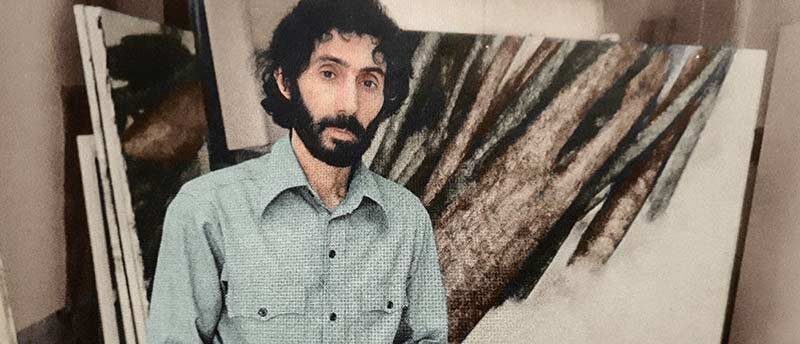
Sohrab Sepehri (1928–1980) was Iran’s rare dual talent — a major modern Persian poet and a modernist painter of trees and desert horizons — whose work today ranks among the most valuable in Iranian art auctions.
Table of Contents
Sohrab Sepehri (1928–1980) remains one of the most quietly radical figures in twentieth-century Iranian art — a painter whose canvases of solitary trees and washed horizons now command some of the highest prices paid for modern Iranian art at auction, and simultaneously one of Persian literature’s most beloved modern poets, whose verse is still recited from memory across the Persian-speaking world. Few artists of his generation, anywhere, sustained that kind of double career at the top of two disciplines at once — and fewer still let one visibly shape the other the way Sepehri did.
Born in the desert city of Kashan and trained as a painter at Tehran University, Sepehri spent much of his adult life travelling and studying abroad — lithography in Paris, woodblock printing in Tokyo, Buddhist philosophy in India — before returning to Iran to make work that fused Persian mysticism with an unmistakably Eastern minimalism. Today his paintings anchor major museum collections and change hands for six figures at international sales, a market presence Aurora & Athena has itself been part of through its own auction catalogs.
A Life Between Kashan and the World: Sohrab Sepehri’s Biography
Sohrab Sepehri was born on 7 October 1928 in Kashan, a caravan-route city in central Iran known for its rose gardens, historic courtyard houses, and desert light — all of which resurface constantly in his later work. He came from an artistically inclined family: his father, Asadollah Sepehri, was a postal clerk who also played the tar and practiced calligraphy, and it was his father who first encouraged the young Sohrab to paint. His grandmother, Hamideh-Banu Kalantar Zarabi, was herself a poet, part of what has been described as one of Kashan’s most prominent literary families, per en.wikipedia.org.
Sepehri finished his early schooling in Kashan before moving to Tehran in 1943, and ultimately earned a degree from the Faculty of Fine Arts at Tehran University in 1953. What followed was more than a decade of near-constant travel that shaped his mature style: he enrolled at the École des Beaux-Arts in Paris in 1957 to study lithography, then travelled to Tokyo in 1960 for an extended apprenticeship in woodblock printing under the Japanese master Unichi Hiratsuka.
From Japan he continued on to India, where he immersed himself in Buddhist philosophy, and over the following years he also passed through China, Afghanistan, Pakistan, Greece, Egypt and much of Western Europe. His work was shown internationally during this period too, including at the Venice Biennale in 1958 and the São Paulo Biennial in 1963.
In 1964 Sepehri resigned from a government post he had held in Kashan’s education office to devote himself entirely to painting and poetry. An extended stay in New York around 1970 — where he later described feeling “desperately alone in the city, with no birds and no trees” — became the emotional source of one of his best-known bodies of work, the Tree Trunk series. He was diagnosed with leukemia in the late 1970s, travelled to England for treatment in 1978, and died in Tehran on 21 April 1980 at the age of 51. He is buried at Mashhad-e Ardahal, near his native Kashan.
Poet and Painter: How Sepehri’s Two Vocations Intertwine
What sets Sohrab Sepehri, poet and painter, apart from most artists of his era is that neither half of his career was a hobby practiced alongside the other. He is counted among the handful of poets who reshaped modern Persian literature, and independently among Iran’s most significant modernist painters — a duality remarkably rare even among artists who dabbled in both forms. His major poetic achievement, Hasht Ketab (“Eight Books”), was published in 1976 and gathers together seven earlier collections alongside a final volume, effectively assembling his complete poetic output into a single, now-canonical text of twentieth-century Persian literature.
The connection between the two disciplines was not incidental. Sepehri’s poetry favors short, spare, almost broken lines built around recurring natural imagery — water, trees, light, silence, solitude — the same vocabulary that dominates his canvases. Critics and biographers have described the relationship as reciprocal rather than one simply illustrating the other: his painting can be traced within his poetry, and his poetry can, in a sense, be heard inside his painting. Both were shaped by the same well of Buddhist and mystical influence he absorbed on his travels, which taught him to find beauty in impermanence and to strip both a line of verse and a brushstroke down to its essentials.
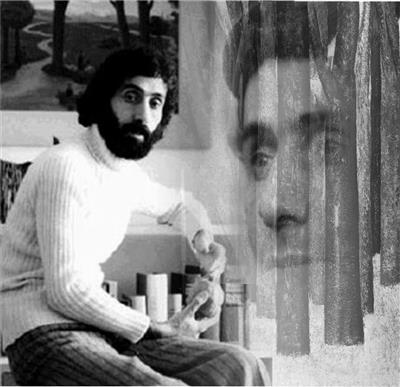
Sepehri’s Painting Style: Trees, Texture, and Eastern Light
Sepehri’s mature canvases are immediately recognizable: solitary tree trunks, sparse branches, and open horizon lines rendered in muted greys, ochres, and soft greens, built up in thin, layered washes rather than heavy impasto. He developed what has been called a “Texture” technique, often working in isolated settings around Kashan’s deserts and the rural village of Ghariyeh Chenar, letting the ground and the paint surface itself carry as much expressive weight as the imagery painted on top of it. Calligraphic, gestural marks sit alongside near-abstract passages, a balance that keeps the work legible as landscape while pulling it firmly toward abstraction.
That style is inseparable from his travels. The six months he spent studying woodblock printing in Tokyo under Unichi Hiratsuka exposed him directly to Japanese material culture and Zen aesthetics, and his subsequent immersion in Buddhist philosophy in India reinforced an interest in emptiness, impermanence, and quiet — qualities that show up in his paintings as negative space and restraint rather than as any literal Buddhist iconography. It’s a genuinely cross-cultural synthesis: a painter trained in the Persian miniature tradition and Tehran’s mid-century modernist circles, absorbing Parisian lithography, Japanese woodblock discipline, and Indian mysticism, and resolving all of it into a spare, distinctly personal visual language.
The clearest example of travel translating directly into subject matter is the Tree Trunk series, painted after his 1970 stay in New York, where the absence of the natural world he was used to left him, in his own words, feeling stranded amid concrete with “no birds and no trees.” One canvas from that series, Untitled (from the Tree Trunk Series), sold at Bonhams London for £187,562.50 in 2019 — a useful marker of how sought-after this particular body of work has become among collectors, per bonhams.com.
Sohrab Sepehri in Today’s Art Market
Sepehri is consistently ranked among the most commercially significant Iranian artists at auction, both in the international Middle Eastern art sales run by the major houses and in Iran’s own domestic auction market. Beyond the 2019 Bonhams Tree Trunk result noted above, his work has realized well over $150,000 at Christie’s Dubai sales of Middle Eastern Modern and Contemporary Art, and within Iran itself a Sepehri canvas titled High Horizon set an all-time sales record for the Tehran Auction in July 2026, hammering at roughly $203,000.
That domestic result underlines a broader pattern: demand for his paintings has, if anything, intensified in the decades since his death, as both regional and international collectors have come to treat him as a benchmark name in twentieth-century Iranian modernism.
That standing is part of why Aurora & Athena’s own catalogs have featured a Sepehri lot: his work sits at the intersection of strong museum validation and genuine collector demand, which is exactly the profile the house looks for when sourcing twentieth-century paintings from outside the traditional Western canon. It’s a pattern collectors will recognize from our earlier coverage of Russian art of the 20th century — modernist movements that developed largely outside Paris, London, and New York, went comparatively undervalued for decades, and are now being actively rediscovered and reassessed by international buyers.
Sepehri’s paintings are held in institutional collections including the Tehran Museum of Contemporary Art, the Metropolitan Museum of Art in New York, and the Grey Art Gallery at New York University — the kind of institutional footprint that tends to support long-term collector confidence in an artist’s market. Readers interested in seeing where his work sits alongside other twentieth-century painters from beyond the traditional Western canon can explore more 20th-century paintings in our gallery.
Frequently Asked Questions
Who was Sohrab Sepehri?
Sohrab Sepehri (1928–1980) was an Iranian poet and painter from Kashan, regarded as one of the most important figures in twentieth-century Persian literature and Iranian modernist painting. He is unusual for having achieved major, independent recognition in both fields at once.
Was Sepehri a poet or a painter?
Both. Sepehri pursued poetry and painting simultaneously throughout his adult life, earning a Fine Arts degree from Tehran University while also writing the poems later collected in Hasht Ketab (“Eight Books”). Neither discipline was secondary to the other in his career or in how he is remembered today.
What influenced Sepehri’s painting style?
His style drew on Persian mysticism, Zen Buddhism absorbed during six months studying woodblock printing in Tokyo under Unichi Hiratsuka, and Buddhist philosophy encountered during travels in India, blended with a modernist training rooted in Tehran and Paris. The result is a spare, minimalist visual language built around trees, texture, and open horizon lines.
How much do Sohrab Sepehri paintings sell for at auction?
Prices vary widely by size, series, and provenance, but strong examples have realized well into six figures: a Tree Trunk series canvas sold at Bonhams London for £187,562.50 in 2019, and a painting titled High Horizon set an all-time Tehran Auction record in July 2026 at roughly $203,000. Christie’s Dubai sales of Middle Eastern Modern and Contemporary Art have also placed Sepehri works above $150,000.
What is Hasht Ketab?
Hasht Ketab (“Eight Books”) is Sepehri’s collected poetic works, published in 1976. It gathers seven earlier collections along with a final volume written as his health declined, and is regarded as one of the foundational texts of modern Persian poetry.
Artist in this article

Own a Work by Sohrab Sepehri?
Aurora & Athena's specialists provide free valuations and can guide you through consignment to auction or private sale.
Get a Free Valuation