
Antoine Blanchard: The Painter Behind Paris’s Belle Époque Dream
Antoine Blanchard was the pseudonym of French painter Marcel Masson (1910-1988), celebrated for his nostalgic Belle Époque scenes of Paris streets, cafés, and boulevards.
Table of Contents
Antoine Blanchard is the name under which a quietly prolific French painter spent four decades recreating the Paris of the Belle Époque — rain-slicked boulevards, flower stalls, horse-drawn carriages, and gaslit cafés glimpsed as if through a half-remembered postcard. Few painters have done more to fix a romantic, nostalgic image of Paris in the popular imagination, and few are so consistently misunderstood: the name on the canvas was not the name on the artist’s birth certificate.
In this article, we look at who Blanchard really was, what makes his street scenes so immediately recognizable, and where his work stands in the market today — including in Aurora & Athena’s own auction rooms, where his paintings have appeared among our 20th-century European lots.
Who Was Antoine Blanchard? The Man Behind the Pseudonym
“Antoine Blanchard” was the professional name of the French painter Marcel Masson, born on 15 November 1910 and, by most biographical accounts, raised in a small village near the Loire river before the family’s later move north — though it’s worth noting that sources are not perfectly consistent on this point, with some summaries of his life placing his birth in Paris itself. He died on 10 August 1988, generally reported as having spent his final years back in the capital he spent his career painting. Both the artist’s real identity and these biographical details are laid out on Wikipedia’s entry on the artist, which remains one of the more consolidated public references on his life.
Masson’s early training was formal and serious: drawing lessons as a boy in Blois, then study at the École des Beaux-Arts in Rennes, Brittany, where he reportedly won a regional prize for draughtsmanship. In 1932 he moved to Paris and enrolled at the École des Beaux-Arts there, later competing for the prestigious Prix de Rome. His painting career was interrupted by marriage in 1939 and by wartime military service; he returned to art only in the early 1940s, and spent several more years running his family’s carpentry business before committing to painting full-time around 1948.
Exactly why Masson chose to paint under a pseudonym is genuinely uncertain, and it’s worth being upfront about that rather than repeating an invented explanation as fact — biographical sources on the artist openly acknowledge that the timing and motivation behind the name “Antoine Blanchard” are not definitively documented.
What is well established is that adopting a working pseudonym was not unusual among mid-century French painters, who sometimes did so because of exclusive contractual arrangements with particular art dealers. By the late 1950s, dealers and agents were buying Blanchard’s Paris scenes in volume and exporting them to galleries across the United States, a trade that did much to build his reputation as a prolific and dependable supplier of nostalgic Parisian imagery.
A Belle Époque Vision: His Artistic Style and Subject Matter
Blanchard’s subject, almost without exception, was Paris as it appeared roughly between the 1890s and the First World War — a city he had not personally experienced as an adult, and which he reconstructed instead from an assembled archive of sepia postcards, old photographs, and prints of the period. This working method is central to understanding his output: rather than painting en plein air, he worked from these reference images, which explains both the historical costume and carriage traffic in his scenes and the way certain compositions — a particular view of the Arc de Triomphe, the flower market at the Madeleine, the Place de l’Opéra — recur across his catalogue in different light, weather, and season.
His technique favored short, loaded, almost flickering brushstrokes to suggest wet pavement, gas lamps, and the blur of pedestrians and carriages in motion — a legacy of Impressionism filtered through a more illustrative, postcard-literal sensibility. Blanchard is most often discussed alongside Édouard Cortès (1882–1969), the older painter whose own Parisian street scenes he is widely understood to have used as an early model; some accounts describe Cortès as an informal mentor figure during the years Blanchard was developing his mature style.
The two are frequently confused by newcomers to the genre, but specialists note real differences: Blanchard’s early canvases tended toward a darker palette than Cortès’s, with bolder reds and blues, and he never adopted the thick impasto highlights that are a hallmark of Cortès’s work. Blanchard is also grouped with Eugène Galien-Laloue and, more distantly, with earlier Parisian street-life painters like Jean Béraud and Luigi Loir, as part of a loose lineage of artists who made a specialty of nostalgic, weather-drenched Paris.
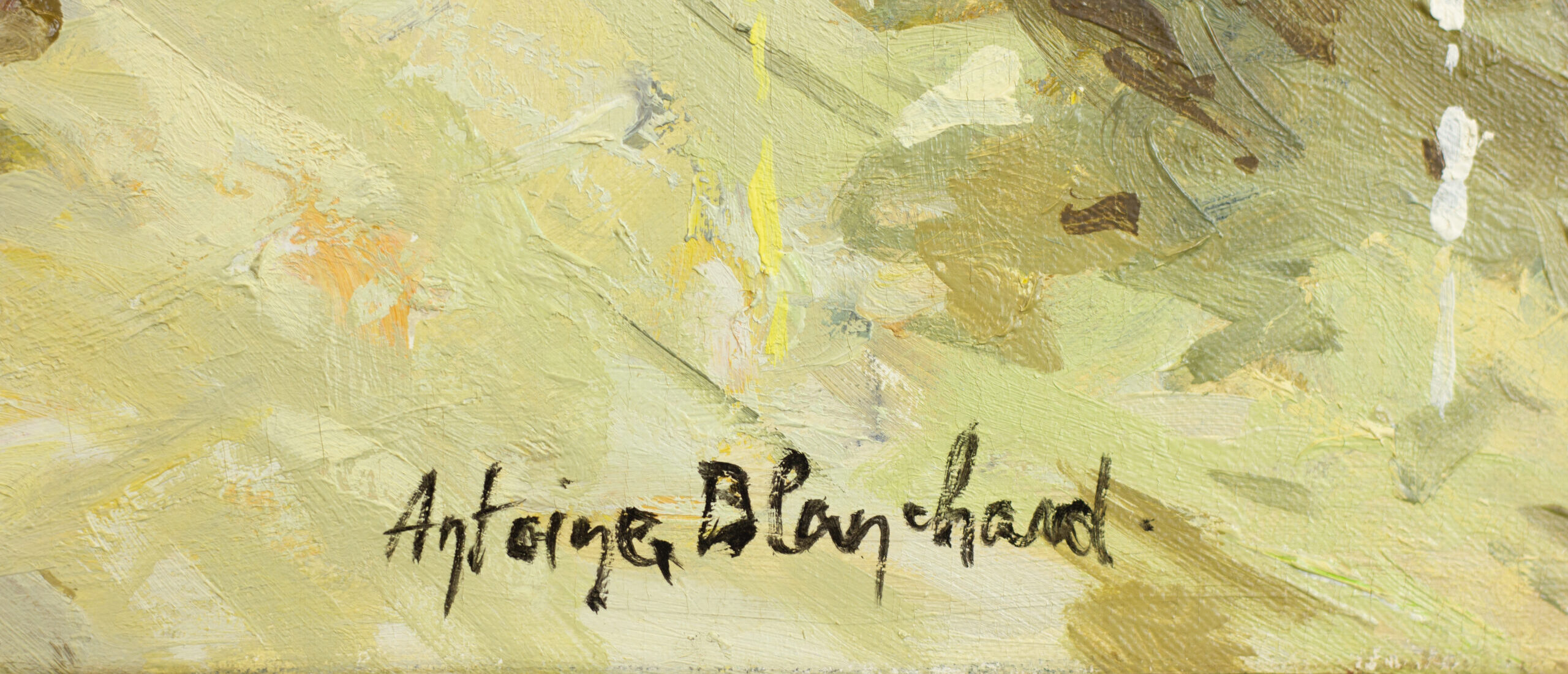
Blanchard was, by every account, extraordinarily prolific — a working habit that served the export trade to American galleries well but has also complicated the market for his work, since his popularity has long attracted forgeries and misattributed copies. Collectors and specialists generally advise expert authentication before a significant purchase, a caution worth repeating for anyone new to buying his work.
Antoine Blanchard in Today’s Art Market
Antoine Blanchard paintings remain a steady presence at auction, reflecting both his large output and his enduring appeal to collectors of decorative, romantic 20th-century European painting. General market data compiled by auction-price databases such as Invaluable’s sold-price records for the artist shows most of his oil paintings — typically in the 13-by-18-inch to 20-by-24-inch range — realizing prices in the low thousands of dollars, with larger canvases and his most sought-after Parisian landmarks, such as views of the Arc de Triomphe or the Champs-Élysées, reaching several thousand dollars and occasionally more at the higher end.
As with any prolific, widely-collected artist, condition, size, subject desirability, and provenance all move the needle considerably from one sale to the next, so these figures should be read as general market context rather than a guide to any single painting’s worth.
Works by Blanchard have appeared in Aurora & Athena’s own auctions as part of our broader program of 20th-century European paintings, including Paris street-scene lots consistent with the artist’s signature subject matter. As with all consignments in this genre, we encourage prospective bidders to review condition reports and provenance carefully — collectors interested in this period of French painting, and in Blanchard’s contemporaries, are welcome to explore more 20th-century paintings in our gallery, and to review our guide to bidding before an upcoming sale.
Legacy: The Last of the École de Paris
By the time of his death in 1988, Blanchard had come to be regarded by dealers and specialists as one of the final active representatives of what is loosely termed the “École de Paris” street-scene tradition — the lineage of painters, running from Jean Béraud and Luigi Loir through Galien-Laloue and Cortès, who made a career of picturing the city’s daily and seasonal life in a consistently nostalgic register. Cortès himself had died in 1969, leaving Blanchard as one of the few painters still actively working in this idiom into the 1980s.
That legacy is, in large part, a market and decorative one rather than a museum one: Blanchard’s paintings are held mostly in private collections rather than major public institutions, circulating through the same network of American and European galleries and auction houses that built his reputation from the late 1950s onward. What keeps his work relevant more than three decades after his death is less a matter of art-historical innovation than of consistent, dependable appeal — his Paris is instantly legible, warmly familiar, and untroubled by the century’s harder edges, which is precisely why it continues to find buyers.
Frequently Asked Questions
Who was Antoine Blanchard?
Antoine Blanchard was the professional name of French painter Marcel Masson (1910–1988), known for nostalgic Belle Époque-style paintings of Paris street scenes, including views of the Arc de Triomphe, the Champs-Élysées, and rainy boulevards lined with flower stalls and cafés.
What was Antoine Blanchard’s real name?
His real name was Marcel Masson. “Antoine Blanchard” was a working pseudonym, a practice that was not uncommon among mid-20th-century French painters working under exclusive dealer contracts. The exact reasons behind his choice of name are not definitively documented.
Is Antoine Blanchard the same artist as Édouard Cortès?
No — they were two distinct painters, though closely associated. Cortès (1882–1969) was the older of the two and is widely regarded as an early model for Blanchard’s Paris street scenes. Their work looks similar at a glance, but specialists distinguish them by palette and brushwork: Blanchard generally used bolder reds and blues and did not use the heavy paint build-up, or impasto, characteristic of Cortès’s highlights.
How much are Antoine Blanchard paintings worth at auction?
Prices vary by size, subject, and condition, but most of his oil paintings realize prices in the low thousands of dollars at auction, with larger canvases and his most iconic Parisian views reaching higher. Because his work has been widely copied and misattributed, buyers should always confirm authentication and provenance before purchasing.
What did Antoine Blanchard paint?
Blanchard specialized almost exclusively in Paris street scenes set in the Belle Époque period, roughly the 1890s through the years before the First World War — boulevards, flower markets, cafés, and famous landmarks such as the Arc de Triomphe and Place de la Madeleine, typically rendered in rainy or overcast light with reflections on wet pavement.
Artist in this article

Own a Work by Antoine Blanchard?
Aurora & Athena's specialists provide free valuations and can guide you through consignment to auction or private sale.
Get a Free Valuation