
Nejad Devrim: Turkey’s First Abstract Painter in Paris
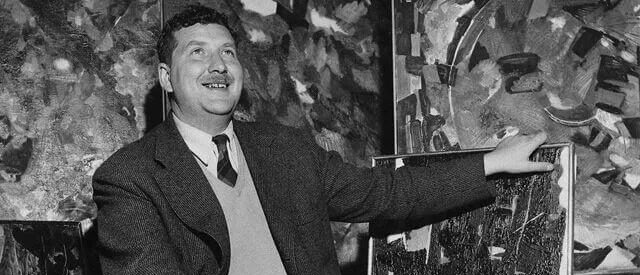
Nejad Melih Devrim opened Turkey's abstract art movement from a Paris studio in 1947. His 2012 Sotheby's record of $1.2 million shows a market still catching up to his significance.
Table of Contents
In April 2012, a canvas titled Abstract Composition, 1952 went under the hammer at Sotheby’s London against an estimate of £250,000–£350,000. Four bidders chased it. It sold for £735,650 — more than double the high estimate, and a new auction record for its maker. Nejad Devrim had been dead for seventeen years by then, and largely forgotten outside a small circle of Turkish collectors for most of them.
That gap between the work and its recognition is the whole story of Nejad Melih Devrim (1923–1995) — the first Turkish painter to hold a solo exhibition of abstract art in Paris, a member of the postwar Ecole de Paris circle that included Sonia Delaunay and Tristan Tzara, and, for most of his life, someone whose own achievement never quite caught up with the company he kept.
A Name Formed by Two Famous Families
Devrim was born in Istanbul in 1923 into a household that produced an unusual concentration of artists. His mother was Fahrelnissa Zeid, the painter whose retrospective at Tate Modern in 2017 confirmed her as one of the major names of 20th-century Middle Eastern modernism. His father, İzzet Melih Devrim, belonged to the Fecr-i Ati literary group, one of the formative movements in modern Turkish writing. His aunt, Aliye Berger, was a printmaker; his cousin, Füreya Koral, pioneered modern Turkish ceramics; his sister, Şirin Devrim, became a stage actress.
He trained at Istanbul’s Fine Arts Academy, studying under Bedri Rahmi Eyüboğlu, Zeki Kocamemi, and Nurullah Berk before completing his studies in the studio of Léopold Lévy. Alongside conventional academy training, he took classes in traditional Ottoman calligraphy and in Byzantine mosaic technique under Professor Thomas Whittemore — the American Byzantinist who led the restoration of the mosaics at Hagia Sophia. Both would shape everything he painted afterward.
Paris, 1947: The First Turkish Abstract Exhibition
Devrim moved to Paris in 1946, at twenty-three. In March 1947, at the Galerie Allard, he held the first solo exhibition of abstract art by a Turkish artist ever staged in the city — adaptations of mosaics from Istanbul’s Chora Church alongside vibrant, color-driven landscapes and still lifes. It was a deliberate fusion: Byzantine surface pattern rendered in the vocabulary of French lyrical abstraction.
The Paris he stepped into took notice quickly. He counted Marcel Duchamp, Gertrude Stein, and Alice B. Toklas among his acquaintances, and the gallerist Leo Castelli — a decade before Castelli became the dealer who defined American postwar art — was among the first to show his work. He exhibited at the Paris May Art Fair for four consecutive years from 1948, and in 1950 was included in Young Painters in the U.S. and France at New York’s Sidney Janis Gallery, sharing walls with Willem de Kooning, Jackson Pollock, and Mark Rothko.
In 1952 he became a founding member and the first president of the Salon d’Octobre, one of the exhibiting societies that structured the postwar Paris abstract scene, and that same year featured in the New School of Paris exhibition at Galerie Babylon — the exhibition that gave the Ecole de Paris its name.
His circle went beyond painters. In 1955 he designed the covers for poetry volumes by Tristan Tzara and Paul Éluard. He showed in Copenhagen and Brussels through the 1950s, spent six months in New York in 1956 exhibiting at Galerie Alexander Iolas, and by every visible measure — gallery representation, exhibition history, the company he kept — was a working artist fully inside the postwar European avant-garde.
Byzantine Mosaics Meet Lyrical Abstraction
Devrim abandoned figurative painting almost entirely once he reached Paris. What replaced it was built on two sources he never really left behind: the tessellated surfaces and gold-ground light of Byzantine mosaic, and the geometric rhythm of Ottoman and Islamic calligraphy he had studied at the Academy. Onto this he grafted the loose, gestural color-handling of French lyrical abstraction — the tendency, distinct from American action painting, that treated color itself as the subject rather than a vehicle for it.
He described his own working principle plainly: nature was not to be imitated, but its meaning explored — color functioning as the primary compositional force rather than description. Art historians today credit him as the first artist to fully integrate abstraction into Turkish painting, and the most significant figure in geometric and lyrical abstraction in the country’s art history. It is a claim that holds up against the record: no other Turkish painter had staged a solo abstract exhibition in Paris before he did, in a city that was, in 1947, still the place such a claim had to be tested.
Poland, Obscurity, and a Posthumous Reappraisal
In 1968, at the height of his exhibiting career, Devrim left Paris for Nowy Sącz, a small town in southern Poland. Sources differ on exactly why, but agree on the effect: it marked the beginning of his disappearance from the French art world that had made him. He stayed in Poland until his death in 1995, largely withdrawn, working with what the gallerist Yahşi Baraz — later his principal advocate — described as an increasingly indifferent attitude toward the art market around him. He experienced real personal loss in these years, including the suicide of his daughter, Senya.
Recognition in Turkey itself only began building meaningfully after 1990, driven largely by Baraz’s efforts to reintroduce his work to Istanbul collectors. Galeri Nev İstanbul mounted a retrospective in 2001 and again in 2018. The pattern is not unusual for artists who worked outside the market centers that write art history in real time — but it means that a genuinely foundational figure in Turkish modernism spent his final three decades almost invisible to the market his early career had helped define.
Nejad Devrim at Auction Today
The market has been catching up since. Sotheby’s has run Devrim as a lead lot in its Turkish and Middle Eastern contemporary sales more than once, and the 2012 result — £735,650 for Abstract Composition, 1952, against a £250,000–£350,000 estimate — remains his benchmark price (sothebys.com). It sits inside a broader run-up in prices for 20th-century Turkish and Middle Eastern modernism generally, a category that includes his mother’s market — Fahrelnissa Zeid’s own record prices have climbed well past his in the years since her Tate retrospective, which has in turn kept renewed attention on her son’s work too.
Works by Devrim have appeared in Aurora & Athena’s own auction catalogs, part of our ongoing focus on 20th-century modernism from outside the traditional Paris-London-New York axis — the same reasoning behind our coverage of Russian émigré painters of the same period, artists whose historical importance the market is still, in real terms, pricing in.
Collectors interested in postwar abstraction with a documented exhibition history and a genuinely singular biography behind it can browse current 20th-century paintings in our gallery or follow our upcoming auctions for future Devrim lots.
Frequently Asked Questions
Who was Nejad Devrim?
Nejad Melih Devrim (1923–1995) was a Turkish painter who became the first Turkish artist to hold a solo exhibition of abstract art in Paris, in 1947. He is regarded as the founding figure of abstraction in Turkish painting.
Was Nejad Devrim related to Fahrelnissa Zeid?
Yes — Fahrelnissa Zeid was his mother. Both are counted among the most significant Turkish painters of the 20th century, though their careers and market recognition followed very different timelines.
What art movement was Nejad Devrim part of?
He was a central figure in the postwar Ecole de Paris, the loose circle of largely foreign-born abstract painters working in Paris after 1945, and was a founding member and first president of the Salon d’Octobre exhibiting society in 1952.
What influenced Nejad Devrim’s painting style?
His work fused two sources from his Istanbul training — Byzantine mosaic technique, studied under Thomas Whittemore during the Hagia Sophia restoration, and Ottoman calligraphy — with the color-driven vocabulary of French lyrical abstraction.
How much do Nejad Devrim paintings sell for at auction?
His auction record is £735,650 (roughly $1.2 million), set at Sotheby’s London in April 2012 for Abstract Composition, 1952, against a pre-sale estimate of £250,000–£350,000. Prices below that vary considerably by period, size, and provenance.
Artists in this article
Considering Selling a Piece From Your Collection?
Aurora & Athena's specialists provide free valuations and can guide you through consignment to auction or private sale.
Get a Free Valuation